
Browse using the new Vinous website now. Launch →
Printed by, and for the sole use of . All rights reserved © 2015 Vinous Media
Inflections In Chardonnay: Chablis 2024 & 2025
BY NEAL MARTIN | AUGUST 11, 2026
Chablis: a town still adrift in a sea of verdant nothingness, lost to the outside world, so that the shoes of even diehard Burgundy aficionados have never met Kimmeridgian soil. I dump my luggage and saunter down to the river to decompress after the long but thankfully undemanding drive. It is early evening and yet hardly a soul can be seen, the main thoroughfare unpeopled, denizens vanishing seconds before my arrival. The picture-postcard scene is little changed over many years, but it never ceases to entrance. As the setting sun sketches the sky pastel pink, beyond the terracotta rooftops I catch sight of serried vines tumbling into the town’s fringe. Even the most vaunted Grand Crus are rooted a convenient stroll away. Geraniums blot the riverbanks with improbable hues and weeping willows shade its running waters; dragonflies skim round lily pads and below, families of trout swim against the current, stationary, like joggers running on the spot.
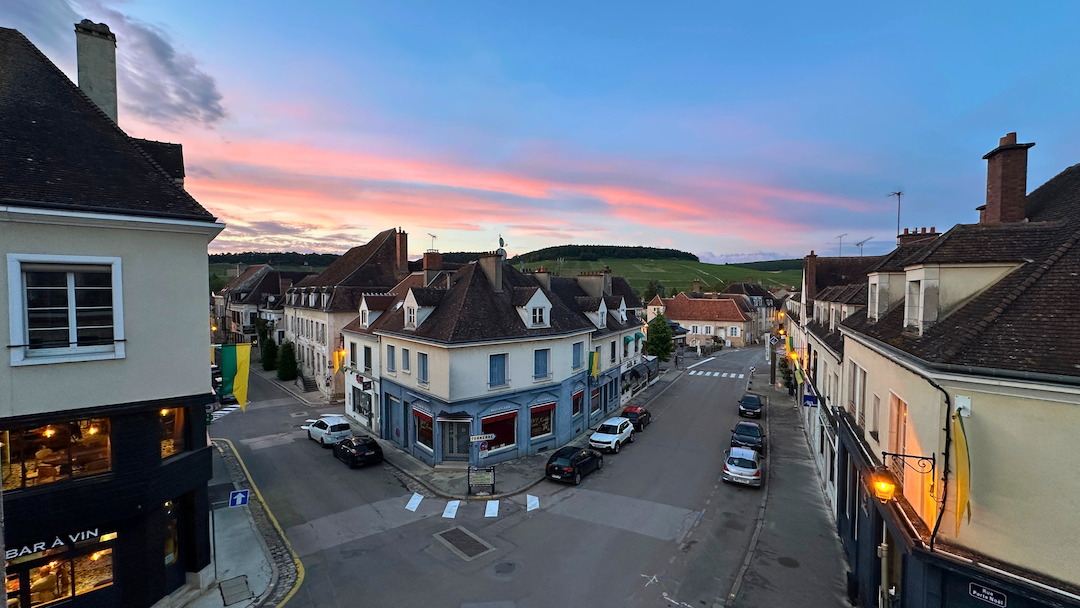
Chablis Ville.
Such serenity, silence and solitude beg contemplation. I ask myself the banal question: What is Chablis wine? Hmm… A bit late given that it is nigh three decades since I first visited what was then a rather timeworn town trapped in aspic. It dawns on me that the answer is playing in my headphones…
Chablis is to wine what Steve Reich is to music. Yes, you can quote me on that. To be precise: Reich’s seminal “Music for 18 Musicians.” His minimalist masterpiece revolves around an eleven-chord cycle whose harmonies deftly modulate and prefigure the next passage. Likewise, Chablis is Chardonnay whose subtle variations etch the nuances between, say, Mont de Milieu and Montmains, Les Clos and Les Preuses. Just as the subtle addition or subtraction of a single note alters a chord and the emotion provoked, so Chablis’ mosaic of terroirs conjures a similar effect. Chablis and Reich share an uncompromising approach that repurposes limitation as an asset. What is achievable with the minimal tools in your box? Chablis’ stripped-down Chardonnay does not acquiesce to the whims of wine drinkers. It is more aloof and distant, as I have written before, sometimes even mean. Therein lies its paradoxical beauty: Chablis is relatively unfettered by direct human intervention. The winemaker’s role is not reduced; more accurately, it is restricted to a guiding hand from bud to fruit, must to wine. Typicité is paramount to distinguishing Chablis from the ocean of Chardonnay from the Côte d’Or, even though there exists a stylistic overlap.
In the gloaming, the town is slowly swallowed by darkness. Time to put contemplation aside and set about my investigation of two almost diametrically opposed growing seasons in Chablis: 2024 and 2025. Which one would tickle Steve Reich’s palate?
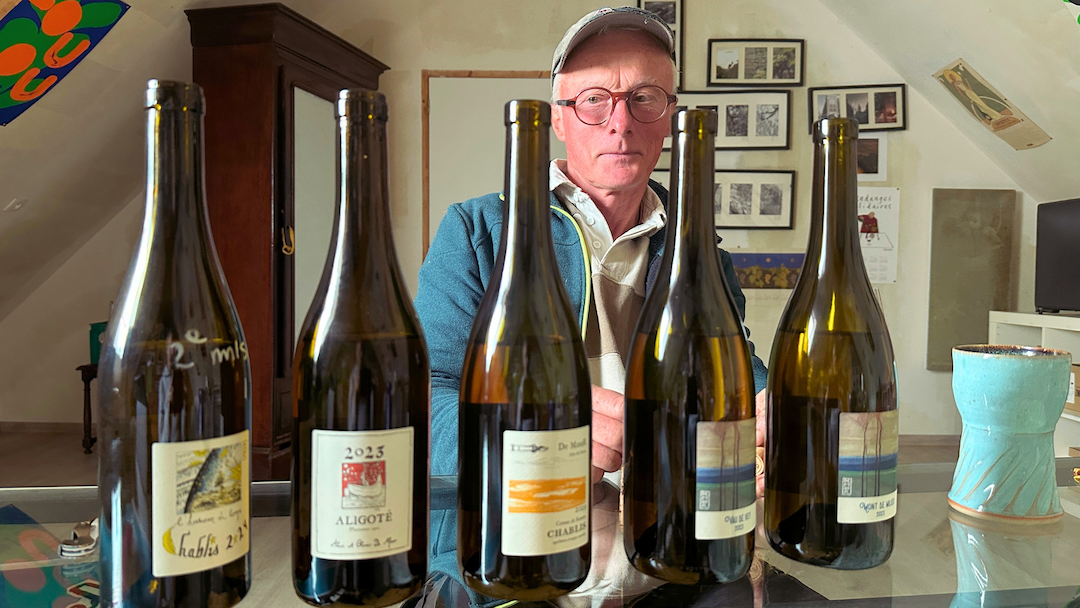
Alice and Olivier de Moor (pictured here) have suffered from weather extremes, due in no small part to their eschewing of all non-organic treatments. Volumes have been pitiful, yet the wines deliver in bottle time and again.
The Growing Seasons
I summarised the 2024 growing season in last year’s report. However, to provide juxtaposition with the following vintage, it is useful to retrace a season so wet that the town of Chablis needed wringing out twice due to floods.
Chablis was constantly drenched with rain: 128 mm in March, 196 mm in May and 117 mm in June compared to the previous year’s 74 mm, 40 mm and 76 mm, respectively. There was no respite, nary a dry window to protect vines from mildew, exacerbated by the quagmire underfoot that made tractors treacherous to steer. According to Didier Séguier at William Fèvre, there were two hailstorms in April and another in May, the latter destroying 40% of their production, plus localised frost damage. Producers who are organic or biodynamic and cannot resort to more effective chemical sprays bore the brunt. Irrespective of vineyard husbandry, there was no option but to be constantly in and out of the vines. Vincent Dauvissat sprayed 23 times, Julien Brocard 18, Edouard Vocoret 19 — some growers forsook organic certification altogether. It goes without saying that temperatures and solar hours were way below average. April to September saw temperatures 0.2°C below normal, with 97 hours fewer of sunshine and 29% more rain.
Unsurprisingly, harvest began later than normal. Perhaps a few winemakers were becoming accustomed to pickers entering the vines at the end of August, but in 2024, most teams trooped into vineyards around September 20. August’s more clement weather had lifted spirits, with a much-needed 263 sunlight hours and average temperatures of 21°C, though that was accompanied by 78 mm of rain, over twice as much as in Mâcon down south. During picking, the mercury tumbled to average temperatures of just 15.3°C (compared to 19.0°C in 2023). In some ways, harvest was easier because there was less to pick. On the other hand, pickers had to be more meticulous about what they put into their baskets. Though the headline was that the region picked half the normal amount of fruit, yields did vary between vineyards. Even in this challenging season, some plots achieved an almost normal yield.
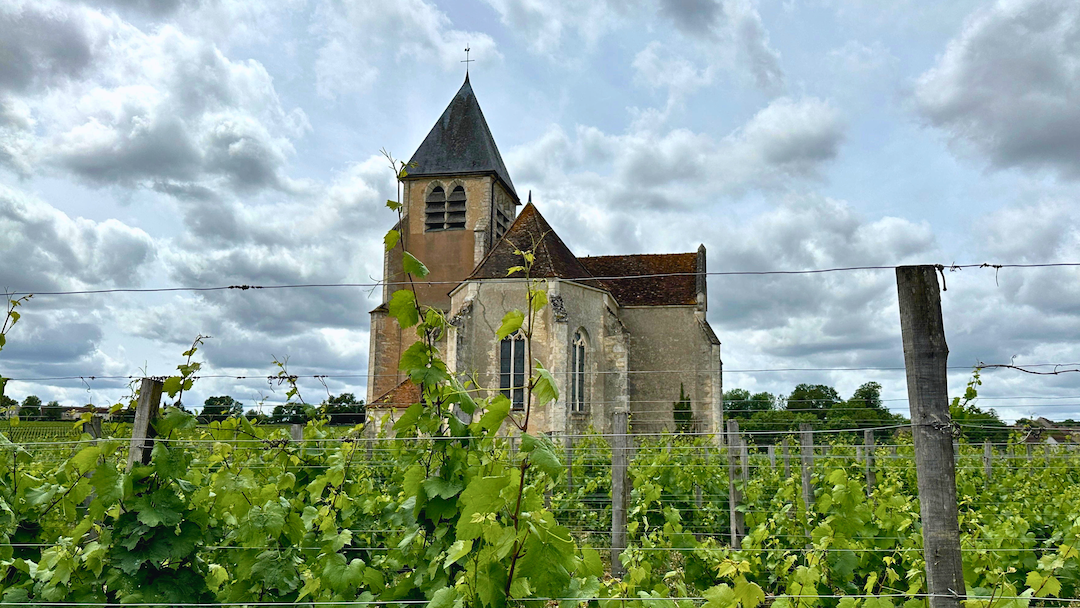
L’Eglise de Saint-Claire in Préhy, just outside Domaine Brocard.
The complications did not stop there. Winemakers had to fill their presses — easier with a vertical basket press but harder with a horizontal pneumatic press — then transfer sufficient musts to fill their vats for alcoholic fermentation. Some producers, like Goisot, were lucky to already have smaller vats at their disposal, but others had to think on the spot in terms of maintaining barrel rotation and so on.
The 2025 vintage is woven from a completely different cloth. It saw a relatively rapid start to the growth cycle due to warm temperatures in the first three months, though February and March were drier than usual, even though reserves would have been replenished after the previous year’s downpours. April witnessed localised frost; it was interesting to hear how some winemakers were barely scratched whilst others lost 40-50%. Samuel Billaud remarked that frost was more severe on the Right Bank than the Left. June was the warmest since 2003, with temperatures averaging 21.5°C and a whopping 315 sunlight hours. Flowering was earlier than usual by around 10 to 12 days, mi-floraison on May 30 compared to the normal June 12. This provoked convectional storms that dumped 50 mm on the region, occasionally with a side order of hail towards Auxerre. The mercury wavered around normal in July. August began with a wave of warm temperatures that peaked around August 12 to 15, when it reached 40°C in some places; there were also 275 sunlight hours (above average). This would typically accelerate the growth cycle, but as Benoît Droin pointed out, vines were fatigued by the sturm und drang of the previous year, which occasionally slowed their development. As explained by Isabelle Raveneau, this could reduce the number of eventual bunches due to impacted initiation florale.
The weather changed on August 19 with the arrival of storms. There was more rain in Chablis than other Burgundy appellations: 119 mm compared to 89 mm in Beaune, which created perfect conditions for rot. A majority of growers, including William Fèvre and Domaine François Raveneau, expedited picking and hired more hands, which is easier in earlier vintages since younger people are yet to return to their studies. Of course, domaines that continue to harvest mechanically had an advantage — Droin is a notable example. Richard Rottiers, wearing his Chablis rather than Beaujolais casquette, averred that the increase in earlier August pickings obliges machine-picking, because the hot days accelerate sugar levels to the extent that one or two days late can completely compromise a wine’s balance. Indeed, Rottiers explained that he has tasted identical trial cuvées: one machine-harvested and the other picked by hand. “I could not tell the difference,” he explained. “The only disadvantage is volume, since you can lose 20% to 25% using machine.” The team at Fèvre was sheathing their secateurs by September 5. On the other hand, Fabien Moreau pointed out that the fruit was not yet phenolically ripe and that he prefers a bit of botrytis in the vat, rather than being forced to chaptalise potentially underripe fruit.
In a nutshell, between April and September (the growth cycle), temperatures were 0.86°C above average with an additional 169 sunlight hours, though there was also 12.5% more precipitation. Berries tended to be fragile and contain less juice than some winemakers had hoped after the depleted 2024 vintage. Everything is relative, so even if that was the case, the consensus was that 2025 was better than the previous year, unlike in Mâconnais, which I will discuss in my forthcoming report.
How I Tasted the Wines
My tastings were conducted either blind at the BIVB offices, where wines are tasted in order of status from Petit Chablis to Grand Cru, or during visits to wineries. As expected, there were fewer submitted samples due to the diminished volume of 2024s, freeing up more time to conduct visits. Unlike in previous years, the La Chablisienne cooperative declined to submit samples. That is a pity because not only do they continue to supply around one-fifth of all Chablis wine, but they often represent good value. I hope the reason was simply the paucity of available wine. On the other hand, I welcome back the Montreal émigré, Patrick Piuze, to this report, plus a couple of others.
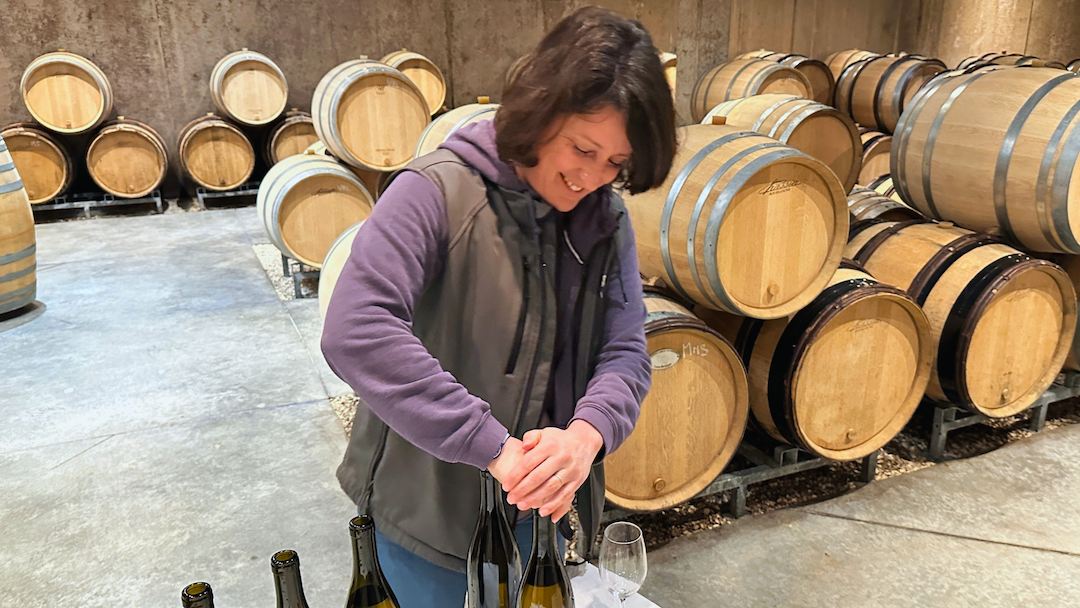
Isabelle Raveneau represents the third generation of family ownership at Domaine François Raveneau.
The Wines
Last year, two words in my report gave an indication of how 2024 Chablis might play out…
Simmering positivity.
Memories of those arduous days in the vines, spraying repeatedly for diminishing returns, if any return at all; the physical and mental anguish salvaging what you can in a season that gave absolutely no relief — all are eventually in the rear-view mirror. At that point, winemakers can take stock of what they produced in more sober fashion. Tasting the 2024s, the wines begin to emerge in a more positive light. Whilst producers might not wish to repeat that vintage, the most successful 2024s beat the odds and turned frowns upside down for winemakers and Chablis purists alike.
Those who prevailed were able to eke out wines that can be compared to the finest whites in the Côte d’Or, albeit leaner and more tensile articulations of Chardonnay. The wines are, in some ways, atavistic, harking back to an old style of Chablis that populated the 1980s or 1990s, a style that some thought is no longer possible. At estates where I could directly compare 2024 and 2025, such as Raveneau and Christian Moreau et Fils, I err towards 2024, but by no means is it a consistent vintage. As I suggested last year, the wines occasionally feel enervated towards the finish. Exhausted vines plus exhausted winemakers equals exhausted Chablis. No doubt many cuvées had to be chaptalised, though sugar seems to have been added judiciously rather than blatantly. Moreover, as Richard Rottiers pointed out, one can speculate how many 2024s were bolstered by the addition of excess wine from 2023 — perfectly legal up to 15%. Of course, it is always “someone else” whenever I enquire! Plenty of 2024s channel malic notes and linearity, hallmarks of great Chablis. The major caveat for buyers is volume: with such small yields, some cuvées are non-existent, another bonus of adding juice from the previous vintage. When all is said and done, the finest 2024 Chablis are a reward for those who persevered and never quit. It’s the least they deserve.
The 2025s certainly have promise, but time will tell. The double whammy of August heat wave followed by incessant showers throughout harvest forced winemakers’ hands and literally dampened potential. The pitfalls of overripe berries and dilution were tricky, though not impossible, to avoid. Twenty-five falls into the category of another solar Chablis vintage that can denude wines of typicité and render them feel generic, perhaps without the intensity of the 2022s or the nerve of the successful 2024s. It would not surprise me if the best 2025s come from less precocious, less exposed, southerly-oriented sites. I am adopting a cautious stance for now, though judging by barrel samples from William Fèvre, Edouard Vocoret and Domaine Servin et al — and thanks to general improvements in viticulture and winemaking — there will doubtless be gems in the sand. Suffice it to say that the exact time of picking, i.e., how much fruit was safely in vat before the downpours, is a critical factor.
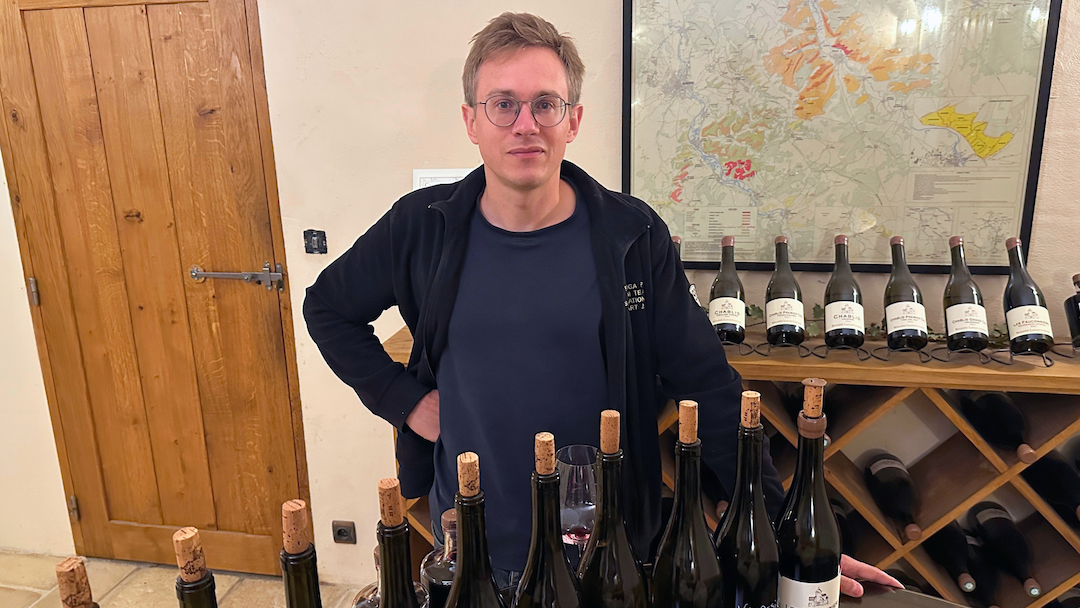
David Lavantureux, together with brother Arnaud, crafts outstanding Chablis under the Domaine Roland Lavantureux label.
A Changing Hierarchy
One subject I want to briefly broach is the myopic view towards the region, those for whom Chablis starts and ends with François Raveneau and Vincent Dauvissat, implying that nothing outside these two is worth consideration. That might have been correct 20 years ago, but not now. For a start, Samuel Billaud’s exquisite wines rank alongside that aforementioned pair. Billaud just has a natural gift, the magic touch that elevates his wines to the highest echelon. The market has not caught up…not yet. In addition, several producers are carving solid track records and earning loyal followings, including Edouard Vocoret, Roland Lavantureux, Christian Moreau & Fils, Alice & Olivier de Moor and Raoul Gautherin. I must also namecheck the two leading producers in Irancy and St.-Bris: Domaine Gabin et Félix Richoux, and Jean-Hugue Goisot, respectively, both included in this report.
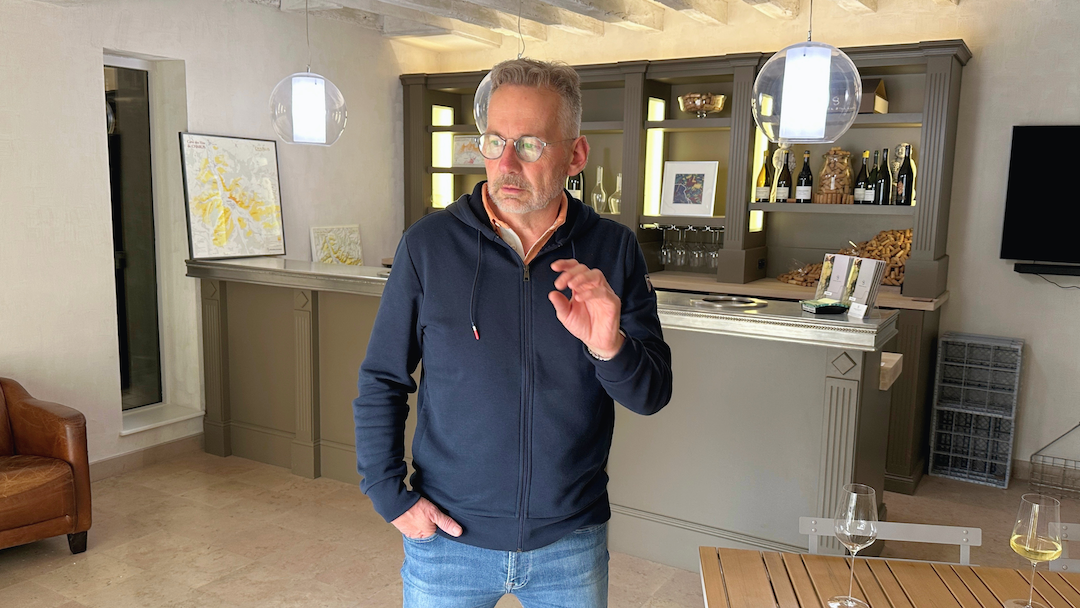
Samuel Billaud, whom I consider to be in the Champions League of Chablis producers.
Final Thoughts
So, what is Chablis? That is a pertinent question that many of producers are asking themselves, as climate change alters expectations and reshapes the future. Cooler vintages like 2017, 2021 and 2024 have become outliers. The crucial question is whether Chablis can cling to its identity. This may be a contentious comment, but I feel too many look at vintages in black and white: decrying solar vintages without appreciating the fact that warmer, drier summers can still produce stellar wines, as I found retasting the 2022 Chablis in May. Meteorological statistics do not tell the whole story, nor do they accurately predict what you will find in your glass. Taste, then decide. Don’t dismiss either cooler or warmer vintages out of hand. View them holistically, a combination of weather, geology, topography, adapted vineyard husbandry and winery techniques.
One change that cannot be denied is a flurry of younger growers who spend more time in the vines, tailoring their pruning or picking earlier to mitigate high sugar levels and excessive tropical traits. The nuances between Chablis’ various climats can be maintained, analogous to those nuanced variations in chord.
Music for 18 Musicians. Chablis for all.
© 2026, Vinous. No portion of this article may be copied, shared or redistributed without prior consent from Vinous. Doing so is not only a violation of our copyright but also threatens the survival of independent wine criticism.
You Might Also Enjoy
Chablis 2023 & 2024: Five Baskets, Neal Martin, July 2025
Chablis 2022-2023: Here Comes the Sun King, Neal Martin, August 2024
Where Art Thou Chablis? - Chablis 2021 & 2022, Neal Martin, September 2023
Swings and Roundabouts: Chablis 2020/2021, Neal Martin, September 2022
Life on the Margin: Chablis 2019/2020, Neal Martin, October 2021
Show all the wines (sorted by score)
- Athenais
- Château de Béru
- Cyprien Arlaud
- Domaine Alice et Olivier de Moor
- Domaine Billaud-Simon
- Domaine Christian Moreau Père & Fils
- Domaine des Malandes
- Domaine Edouard Vocoret
- Domaine François Raveneau
- Domaine Gabin et Félix Richoux
- Domaine Gérard Duplessis
- Domaine Gilbert Picq
- Domaine Guilhem et Jean-Hugues Goisot
- Domaine Jean-Marc Brocard
- Domaine Jean-Paul & Benoît Droin
- Domaine Laurent Tribut
- Domaine Pattes-Loup
- Domaine Raoul Gautherin & Fils
- Domaine Roland Lavantureux
- Domaine Samuel Billaud
- Domaine Servin
- Domaine Vincent Dauvissat
- Domaine William Fèvre
- Famille Gueguen
- Les 7 Lieux - Julien Brocard
- Louis Michel & Fils
- Maison Gautherin
- Patrick Piuze