
Browse using the new Vinous website now. Launch →
Printed by, and for the sole use of . All rights reserved © 2015 Vinous Media
Sicily: Realized Potential and the Road Ahead
BY ERIC GUIDO | SEPTEMBER 22, 2026
Sicilian wine is positioned for greatness. The island's unrealized potential has been clear for decades, but Sicily is finally having its day. There are now more memorable wines than forgettable ones. It’s only the beginning. While much of Italy struggles to adapt to climate change or restore biodiversity to regions dominated by monoculture, Sicily is already well ahead of the curve. It’s as if the entire island has awakened to the realization that its multitude of indigenous varieties offer something truly unique in the global landscape. This report looks at broader Sicily and is companion piece to my Etna report, which we published earlier in the year.
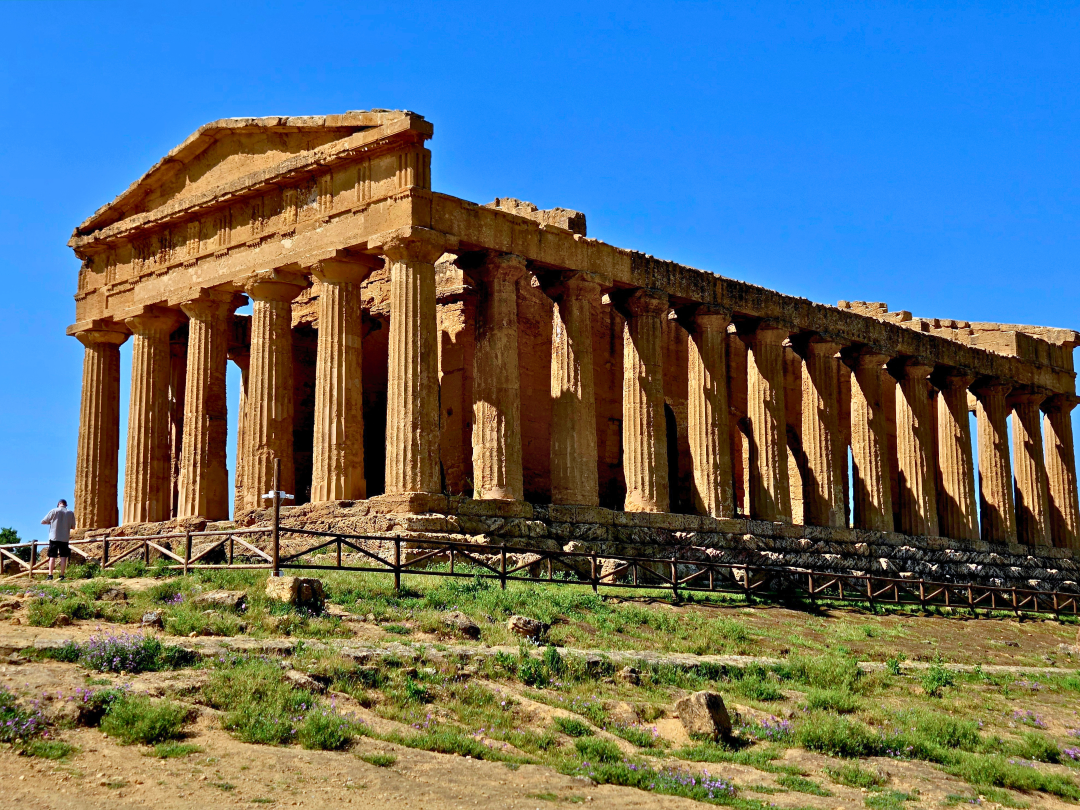
Ancient Greek ruin in Agrigento’s Valley of the Temples.
Sicily's Ancient Roots
Few other places in Italy maintain as intimate a connection to history as Sicily. Local winemakers take immense pride in the relics and ruins that reinforce the importance of viticulture dating back thousands of years. As early as 800 BC, the Phoenicians began commercializing winemaking on the island, using port towns along the western coast to export wine in clay amphorae.
Even more impressive are the ancient Greek palmenti (ancient stone structures used for crushing grapes) throughout the landscape. On my tour of Planeta’s Menfi vineyards, Alessio Planeta took great pride in guiding me through an archaic palmento carved directly into limestone. Similarly, Fabio Sireci of Feudo Montoni pointed out ancient Sicanian caves on his property, evidence of a culture that thrived here thousands of years ago. Modern research supports the theory that these early cave-dwelling societies were indeed making wine.
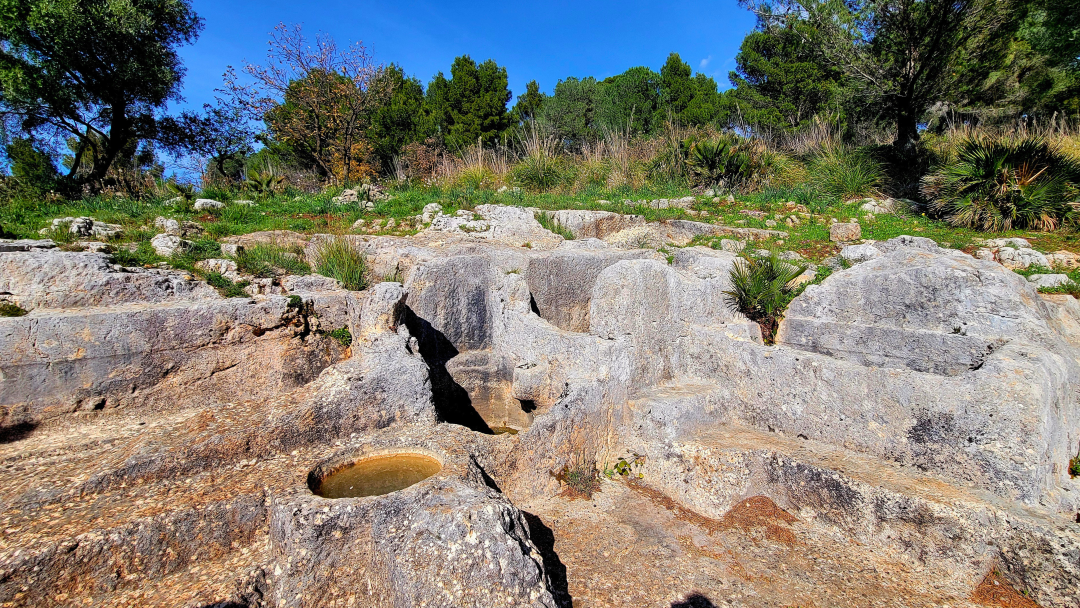
An Archaic palmento on Planeta’s property near Menfi.
Sicily's fertile soils and microclimates have made it an ideal location for agriculture and viticulture across millennia, giving rise to the island's extraordinary biodiversity today. The term feudo, preserved in the names of many Sicilian wineries, dates back to a time when feudal barons ruled over self-sufficient agricultural communities. These families lived within the protective walls of a baglio, a fortified complex built around a central courtyard that functioned as a self-contained village. Many of these bagli remain operational today as wineries, agriturismos or private residences. They serve as reminders of a harsher era that indelibly shaped modern Sicilian culture.
A New Focus on Terroir
While the current success of Sicily’s wine industry rests on its respect for tradition and lessons learned over generations, its future trajectory depends on a new understanding of terroir. The ongoing surge in high-quality Sicilian wine is the result of a convergence: tradition, progressive thinking and a deeper reverence for a winemaker's raw materials — specifically, the site and the grape.
Across the island, a clear shift in strategy is underway. Producers are stepping away from the practice of blending large volumes of fruit sourced from broad regions or DOCs, choosing instead to seek out single-vineyard plots with unique microclimates and soils. While visionary producers on Mount Etna (such as Marco de Grazia, the late Andrea Franchetti, and Frank Cornelissen) initiated this movement around the turn of the millennium, site-specific viticulture has now caught fire in Sicily’s southeastern and central zones.
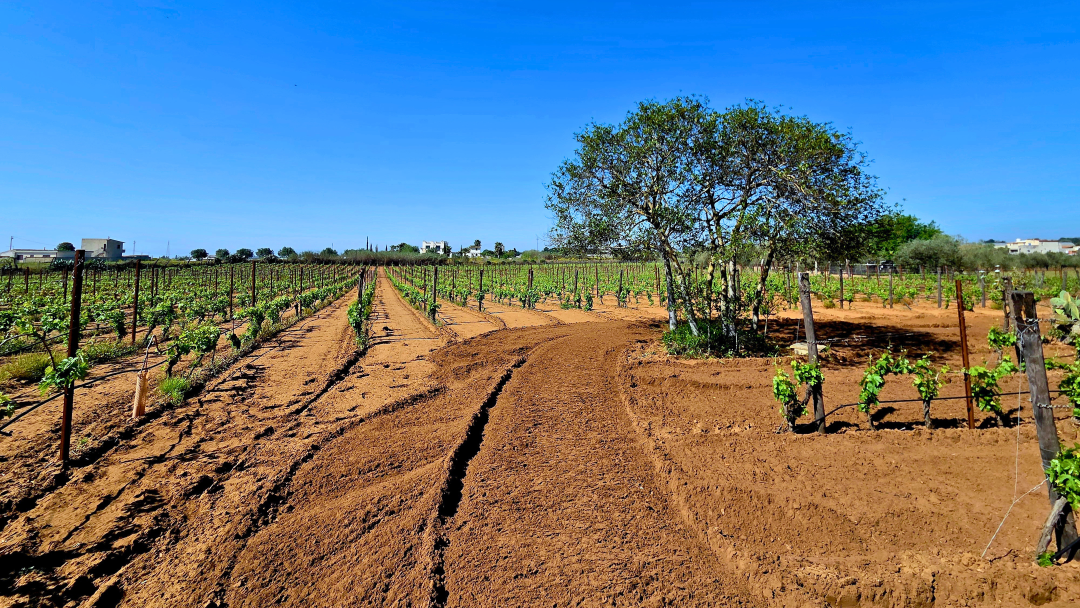
The soils in the Forfice vineyard behind the Paolo Cali winery consist almost entirely of sand.
Nowhere is this shift more evident than in the southeast. In the DOCG of Cerasuolo di Vittoria, the DOC of Noto and the historic subzone of Pachino within the Eloro DOC, Nero d’Avola is proving to be key to Sicily’s future. Ageworthy, highly terroir-transparent and naturally equipped to thrive in extreme conditions, Nero d’Avola is frequently cultivated as traditional, low-trained alberelli (bush vines) to withstand the relentless coastal winds. While other regions of Sicily excel with the variety, growers in the southeast have successfully identified and isolated individual vineyard parcels that showcase terroir. The range of wines from Gulfi, Paolo Calì, Arianna Occhipinti, COS, Feudo Maccari, Marabino and Zisola illustrate precisely this. Southeastern Sicily is a hotbed of viticulture, with forward-thinking winemakers finally receiving recognition. Best of all, readers can get in on the ground floor and line their cellars with many of these wines at exceptionally fair prices.
Frappato, Nero d’Avola’s historic blending partner, is equally important. For Cerasuolo di Vittoria, blending the two yields remarkably complex, cellar-worthy reds. Furthermore, producers like Arianna Occhipinti have recently proven that Frappato, when planted in the right soils and handled with a gentle touch in the cellar, can stand on its own and communicate terroir as a varietal wine. Though this wonderfully fragrant and acid-driven variety is traditionally considered a food wine that pairs well with nearly any cuisine, it is deserving of appreciation in its own right.
Producers like Feudo Montoni and Tasca d'Almerita’s Tenuta Regaleali have long drawn attention to the rugged, central expanse of the Sclafani Highlands, but further east toward Mount Etna lies the high-elevation interior of Enna. I’ve come to regard this province as the island's undiscovered gem for Nero d’Avola and Sicily’s other prestigious red grape, Nerello Mascalese.
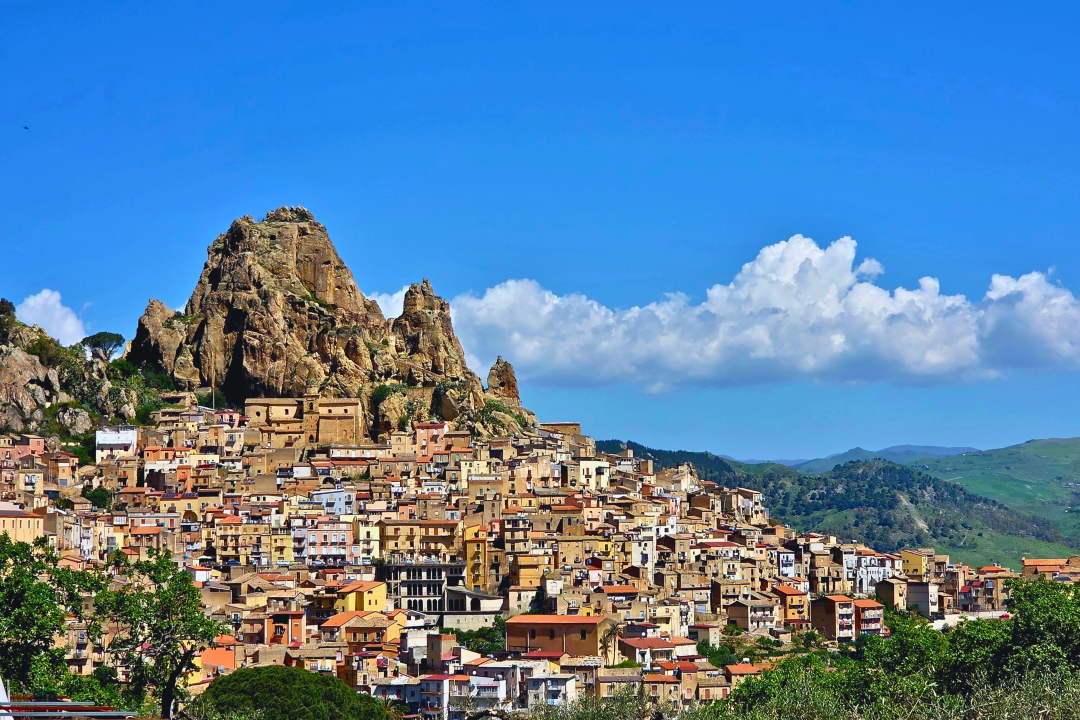
The village of Castello di Gagliano Castelferrato in Enna exemplifies one of Sicily’s recently unexplored terroirs.
Nicolò Grippaldi’s new project in Enna is particularly compelling. Grippaldi established his project in entirely unproven territory — the small village of Gagliano Castelferrato in the province of Enna, where winemaking had historically been limited to bulk table wines for local consumption. The soils in Enna comprise a distinct blend of ancient volcanic material and sedimentary deposits. In 2015, Grippaldi planted his vineyards to Nero d’Avola and Nerello Mascalese using a sélection massale from 200-year-old vines that his great-great-grandfather originally cultivated. Projects like this underscore Sicily's vast, untapped potential for the future and leave me wondering just how many other hidden pockets of terroir await discovery.
A White Wine Revolution
While red wine has taken center stage in Sicily for decades, recent years have seen producers place significantly greater importance on white wines. Aside from Carricante (which I covered in detail in my Etna report) and international varieties like Chardonnay, locals have now turned their attention back to the region's indigenous varieties. A small number of winemakers, like Marco De Bartoli in the Marsala area, began producing important interpretations of Grillo decades ago. Today, excitement over the variety has spread across the entire island, well beyond the coastal zones.
The history of Grillo is fascinating. Sicilian winemakers often regard it as the region's defining white variety, despite Catarratto and Zibibbo having been in the area for thousands of years. Grillo is a mid-nineteenth-century cross between Catarratto and Zibibbo, created to produce a more rugged, serious grape with a better balance of acidity and sugar. Grillo’s original use was in the production Marsala, but ambitious winemakers eventually realized the variety could also yield serious dry wines. Today, Grillo comes in playful, easily quaffable styles as well as in structured versions intended for aging. Coastal areas like Trapani, Agrigento and Palermo produce a sun-kissed, Mediterranean profile, but higher elevations further inland bring acidity and beautifully nuanced aromatics to the forefront. The day I spent tasting dry Grillos for this report was one of the highlights of my recent trip.
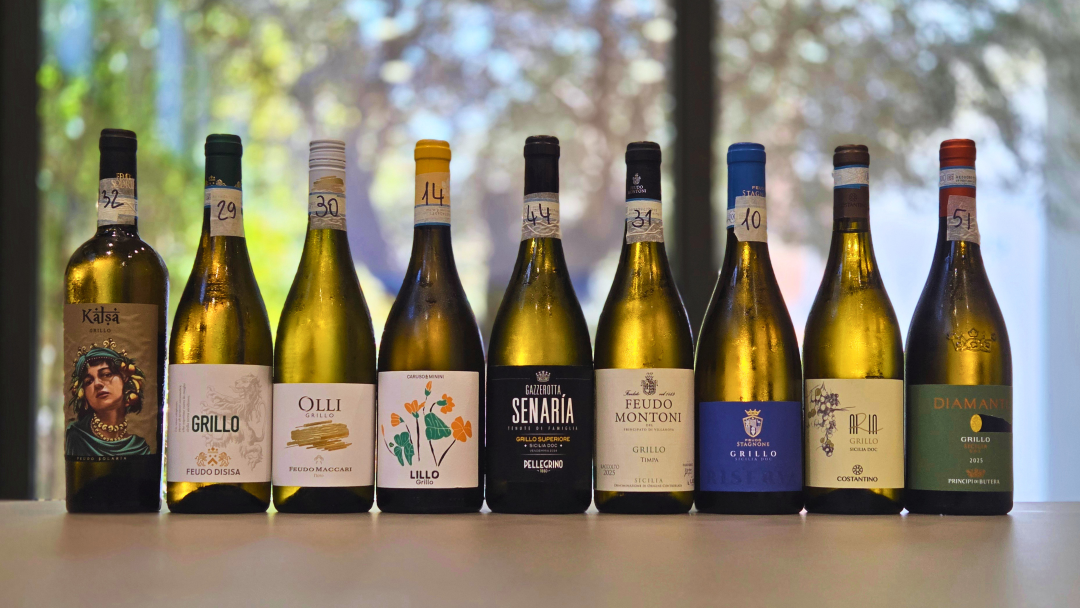
Grillo is establishing itself as Sicily's premier white grape variety.
Zibibbo and Catarratto have yet to receive the same widespread attention as Grillo, but both can yield excellent wines in the right hands. Here again, I must mention Marco De Bartoli, as well as COS, Donnafugata, Colomba Bianca and Curatolo Arini, who all craft compelling Zibibbo. Historically, the island of Pantelleria championed Zibibbo through the production of Passito di Pantelleria (to which Donnafugata’s Ben Ryé brought international acclaim), but dry styles are rapidly gaining traction. Tanca Nica once again impressed me with their portfolio of dry Zibibbo from Pantelleria.
When it comes to Catarratto, winemaker Francesco Loi’s work at the Mazzei family’s Zisola estate in Sicily’s southeast is noteworthy, as are the efforts of Caruso & Minini, Tenute Nicosia, Alessandro di Camporeale and Feudo Montoni. All of these producers deliver wines that balance complexity and energy. Malvasia di Lipari, grown on the volcanic Aeolian islands, delivers mineral- and acid-driven whites that pair very well with seafood. Inzolia, another indigenous variety found throughout western Sicily, yields crisp, fruit-forward whites. There is no shortage of variety in Sicily today.
Vintage Extremes: The Arid 2024 and the Promise of 2025
Assessing each vintage in Sicily is an exercise in understanding the intricacies of its geography. A broad vintage report for the island runs the risk of obscuring how drastically conditions vary across the region. Weather patterns in the east can differ wildly from those in the west, just as the north contrasts with the south.
The island's mountainous interior complicates things further, exerting a cooling influence during warm years. Then, the Sirocco winds blow dry, scorching air up from the Sahara Desert, which can rapidly offset a wet season on the southern coast. Additionally, the surrounding offshore islands each boast their own distinct microclimates. I’m often reminded of anomalous years like 2014, in which much of Sicily suffered through a wet, difficult vintage while Mount Etna enjoyed one of its best on record. Still, a few broad generalizations can be drawn from the past few years.
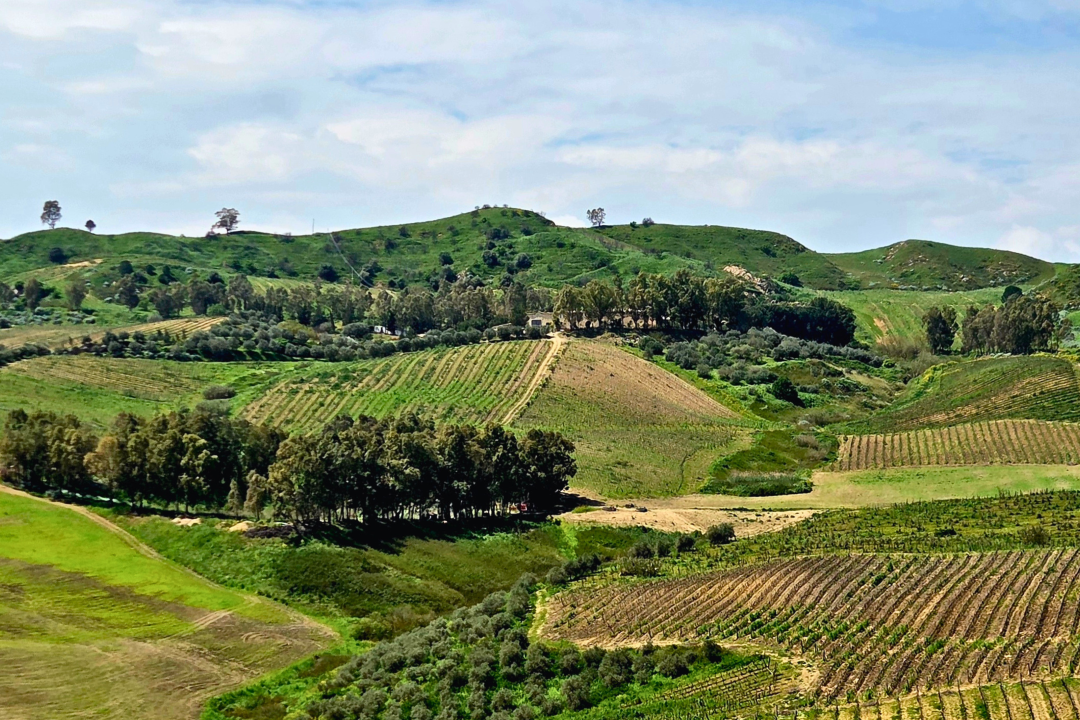
Feudo Montoni champions biodiversity within its mixed farm.
Coming out of the severely rainy and mildew-stricken 2023 growing season, 2024 presented an entirely opposite set of challenges. It was a severe drought year, with the third consecutive winter in which the region received virtually no snowfall. The region then saw very little rain amid unseasonably warm conditions. A brief window of spring precipitation helped restore a degree of balance, followed by an unseasonably warm summer that remained fairly steady and without extreme heat spikes. Still, vines shut down, berries shriveled and skins thickened. Conditions were far less severe on the eastern slopes of Etna, where precipitation is naturally higher, greatly benefiting the production of Etna Bianco Superiore.
Late August and September brought much-needed rain, just enough to restart the vegetative cycle and aid late-harvest regions like Mount Etna. Across Sicily, the harvest generally ran about two weeks ahead of schedule, which explains why some of the white wines (excluding Etna Bianco Superiore) lack energy. Many producers expressed relief over the low disease pressure, but the vintage undeniably left its mark.
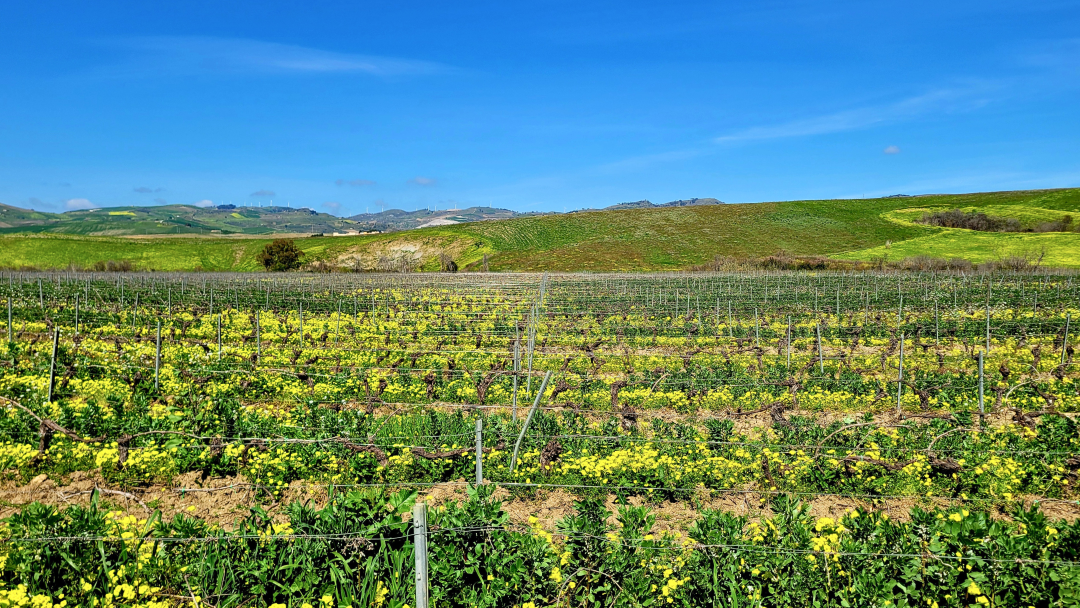
The Contessa Entellina property of Donnafugata in the Belice Valley.
The 2024 reds reflect the year's sun-drenched conditions, showing primary concentration, surprisingly high acidity and dark, rich fruit. The wines are accessible in their youth but occasionally show underripe tannins. The worst examples are fatiguing wines that lack site transparency and complexity. The best are decadent, teetering on the edge of balance, yet quite fun to drink. Yields were down roughly 20% compared to an average season, though still higher than the disastrously low 2023 vintage.
Looking Forward to 2025
There’s a lot of excitement throughout Sicily about the 2025 vintage, and from what I’ve tasted so far, that seems to be warranted. It is far too early to pass judgment, but I cannot deny that the young 2025s I’ve encountered are radiant and pure with vibrant fruit and harmonious acids.
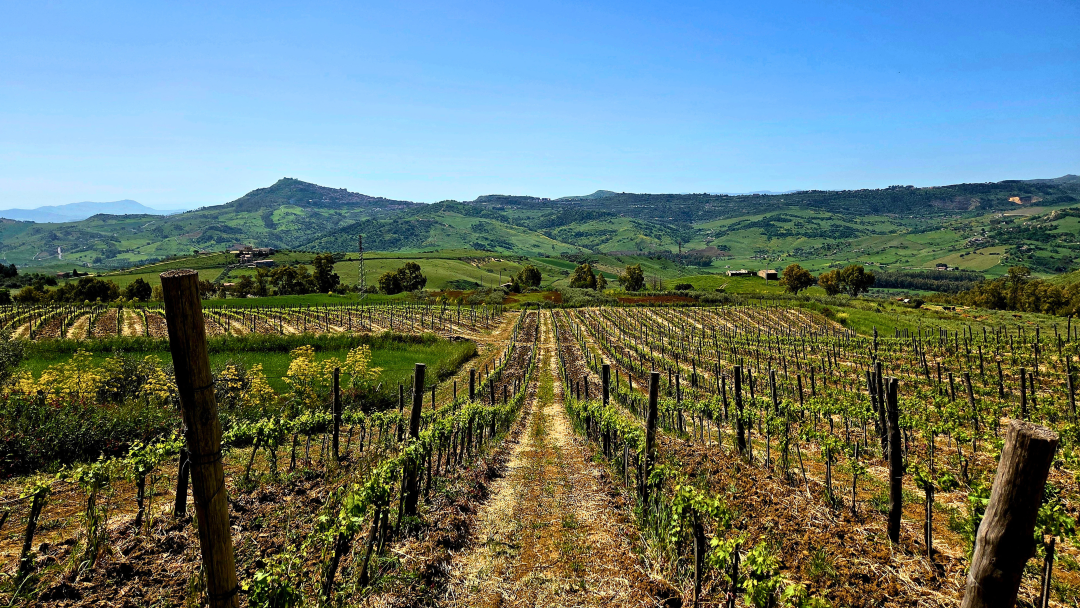
Nicolò Grippaldi’s Nero d’Avola and Nerello Mascalese vines thrive between the highlands to the west and Mount Etna to the east.
Even so, 2025 was not a year in which winemakers could simply go on autopilot. The season began with balanced winter precipitation. While Sicily once again saw no snowfall and experienced warmer temperatures than the historical averages, conditions were more balanced than in the previous three years. Spring brought significantly more rain, which triggered outbreaks of downy mildew, but it was far easier to control than in 2023, and the precipitation bolstered water reserves in the soil. Warm conditions and only sporadic summer rain were just enough to ward off drought and mitigate disease pressure. Fall brought wet and cooler weather, allowing vines to mature fruit evenly and maintain excellent acidity. The harvest was ultimately still early, close to 2024 in terms of timing, but the bunches were healthy and physiologically ripe. The results are perfumed, fruit-forward, vibrant wines with notable acidity that make them exceptionally easy on the palate. How this will translate to the more important wines remains an open question, and one I'll have to wait to answer.
I tasted the wines for this article in Sicily in April 2026, and over the following months at our office in New York City.
© 2026, Vinous. No portion of this article may be copied, shared or redistributed without prior consent from Vinous. Doing so is not only a violation of our copyright but also threatens the survival of independent wine criticism.
You Might Also Enjoy
Mount Etna: The Juggernaut of Italian Wine, Eric Guido, September 2026
Sicily Excels Despite Mother Nature's Wrath: The 2022 and 2023 Vintages, Eric Guido, July 2025
An Eruption of Fine Wine on Mount Etna, Eric Guido, May 2025
Unveiling the Diverse Palette of Sicily: New Releases and Beyond, Eric Guido, June 2024
Surpassing Expectations: New Releases from Sicily, Eric Guido, September 2023
Show all the wines (sorted by score)
- Alagna Vini
- Alessandro di Camporeale
- Ancestrale
- Antonello Cassarà
- Arianna Occhipinti
- Baglio Baiata Alagna
- Baglio Oro
- Barraco
- Biscaris
- Campisidrasi
- Cantina Cellaro
- Cantine Fina
- Cantine Mothia
- Caruso & Minini
- Casa Grazia
- Colomba Bianca
- Colosi
- COS
- Costantino
- Criante
- Curatolo Arini
- Cusumano
- Del Grillo
- Donnafugata
- Duca di Salaparuta
- Feudi del Pisciotto
- Feudo Disisa
- Feudo Maccari
- Feudo Montoni
- Feudo Solarìa
- Feudo Stagnone
- Flavia Wines
- Fondo Antico
- Giovinco
- Gorghi Tondi
- Gulfi
- Gurrieri
- Le Casematte
- Le Fontane
- Liotro
- Mandrarossa
- Marabino
- Marco De Bartoli
- Masseria del Feudo
- Morgante
- Musita
- Nicolò Grippaldi
- Paolo Calì
- Pellegrino
- Peri Peri
- Planeta
- Possente
- Principi di Butera
- Purato
- Salvatore Marino
- Sangue d'Oro
- Santa Tresa
- Santa Tresa & Cortese
- Stemmari
- Tanca Nica
- Tasca d'Almerita - Sallier de La Tour
- Tasca d'Almerita - Tenuta Capofaro
- Tasca d'Almerita - Tenuta Regaleali
- Tasca d'Almerita - Tenuta Whitaker
- Tenuta del Vallone Rosso
- Tenute Navarra
- Tenute Nicosia
- Tenute Orestiadi
- Tola
- Tonnino
- Valle dell'Acate
- Vinding Montecarrubo
- Zisola