
Browse using the new Vinous website now. Launch →
Printed by, and for the sole use of . All rights reserved © 2015 Vinous Media
Lower Austria 2025: Back to the Future
BY ANNE KREBIEHL MW | JULY 30, 2026
The 2025 vintage in Lower Austria is like a souvenir from the past: Grüner Veltliners are textbook examples of peppery verve, while Rieslings come with wonderful cut, afforded by the acidity of a year that had sufficient rain and no real heat spikes. Growers initially thought 2025 was shaping up to be another 2021, but rain just before and during harvest spelled disease pressure. Riesling’s thinner skins are susceptible to botrytis and splitting, and split fruit is a magnet for sour rot and botrytis. The only course of action was meticulous sorting and reduced yields. Grüner Veltliner, on the other hand, weathered it all with aplomb and was mostly picked in excellent sanitary condition.
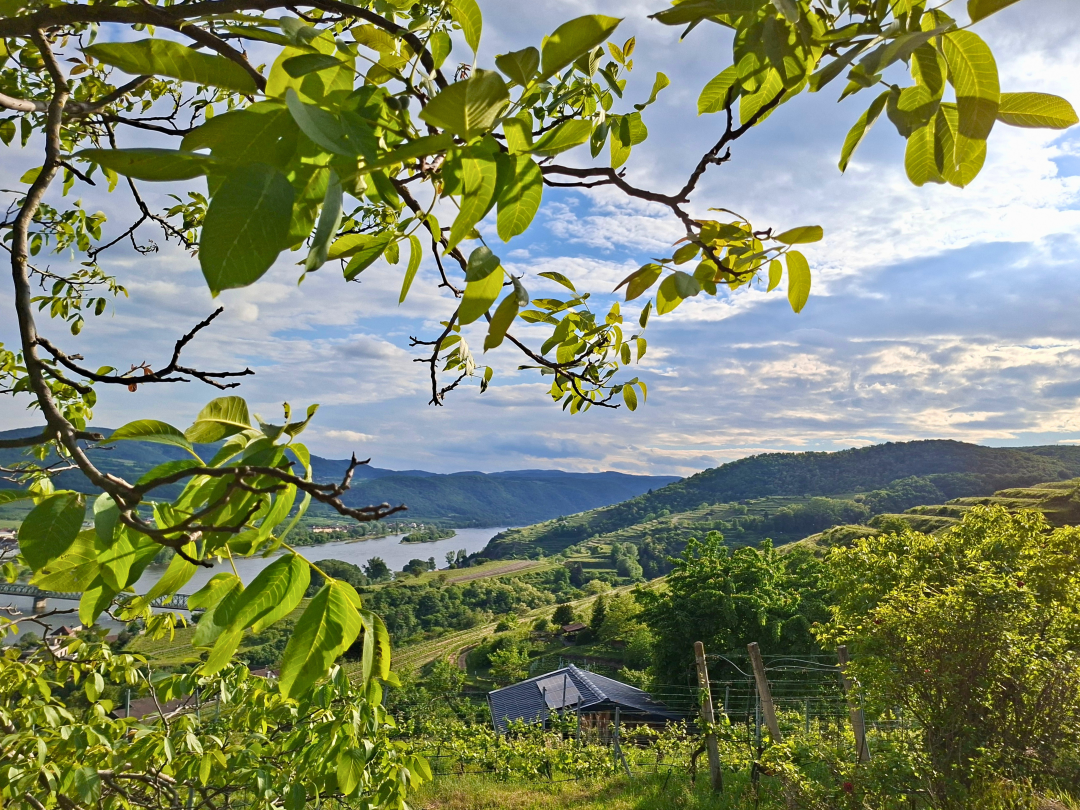
Looking west along the Danube from Ried Schreck in Krems.
Double Takes
Generally, Austrian winemakers — particularly the producers featured here — know that they owe it to their reputations to forego quantity if quality requires it, so the September and October rains affected Riesling yields much more than quality. The expression of 2025 is wonderful: moderate alcohol and high acidity make for heightened aromatics, precision and full-flavored svelteness that I find hugely attractive. On several occasions, I did a double take — was I really tasting on the Danube, or had I been teleported to the Nahe? If you like it racy, 2025 is for you. Another upshot of the rainy harvest is a handful of sweet wines where the grey rot of botrytis cinerea turned into noble rot.
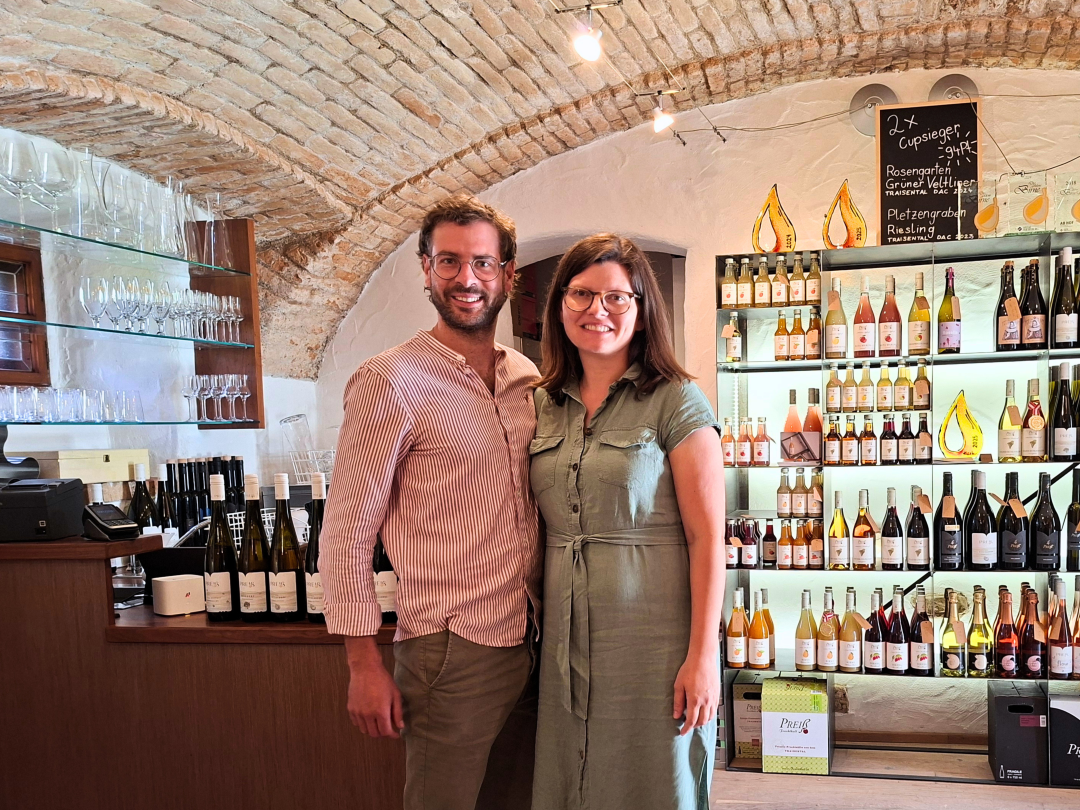
Viktoria Preiss and Klaus Wiebogen are now at the helm of Weinkultur Preiss in the cool Traisental.
Cooler, But Not Cool
Melanie Muthenthaler in the Wachau’s Spitzer Graben put it almost poetically. For her, 2025 was a year of “reconciliation” after the horrible frost and flood events of 2024. Many producers conveyed a sense of calm about 2025, seeming grateful for the lack of drama from extreme weather events. For once, 2025 was not a year where winemakers raced against sugar ripeness and potential alcohols, as a cloudy, cooler July and a late summer with cooler nights and no heat spikes slowed ripening. It would be tempting to call 2025 a “cooler” year, but while it was cooler than recent years, it still was not cool. On the contrary, statistically, official records rank 2025 as the tenth-warmest recorded year in Lower Austria. While these figures are based on the entire year, not on the vine growing season, some data points are telling. January and March were much warmer than average, but May was closer to the historical average from 1961-1990. June was sunny and warm with some high temperatures, but there were no extremely hot phases between July 7 and August 7. In July, there were frequent and heavy rains, and the sun made few appearances. While 2024 saw 38 days of heat (defined as days where temperatures reached or exceeded 30° C), 2025 had only 15. Additionally, there was only one so-called “tropical night” where nighttime temperatures did not dip below 20° C, whereas in 2024 there had been 11. There were no late-spring frosts, only minor hail events, and nobody spoke of dry stress in the vines. The year was indeed calmer, with a steadier and longer growing season. Many estates harvested well into October, and in the cooler parts of the Wachau, even into November.
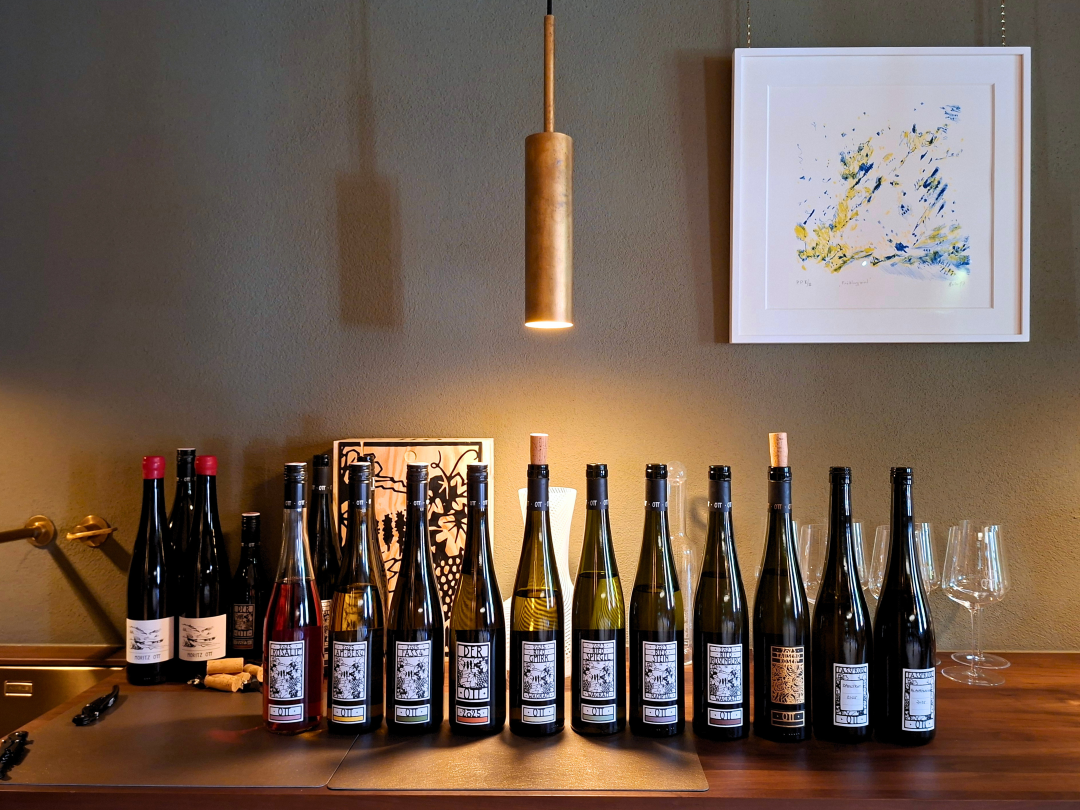
Still life with Grüner Veltliner at Bernhard Ott's tasting room in Wagram.
Handling the Reality
Tested by a few years of extremes and calamities, winegrowers have adapted their strategies. Fritz Wieninger in Vienna was one of the producers who now regularly picks so-called “acid reserves.” These are small pre-harvests of certain sites that are picked before full ripeness when acids are still high. Once fermented, these wines become a useful blending component, even though this was not needed in 2025 due to strapping acidity levels. This kind of measure is far more subtle than acidification with tartaric acid, and is just one element of a more enlightened, contemporary approach. It is now commonplace for growers to fine-tune vine management to the style of wine they want to achieve, whether that means planting field blends rather than single varieties, adjusting pruning times, de-leafing canopies to expose or shade fruit, or training vines differently without a traditional fruiting zone on a trellis to further vary ripeness. The common theme is that these growers are adapting standard practices to individual sites and circumstances, and the wines clearly benefit.
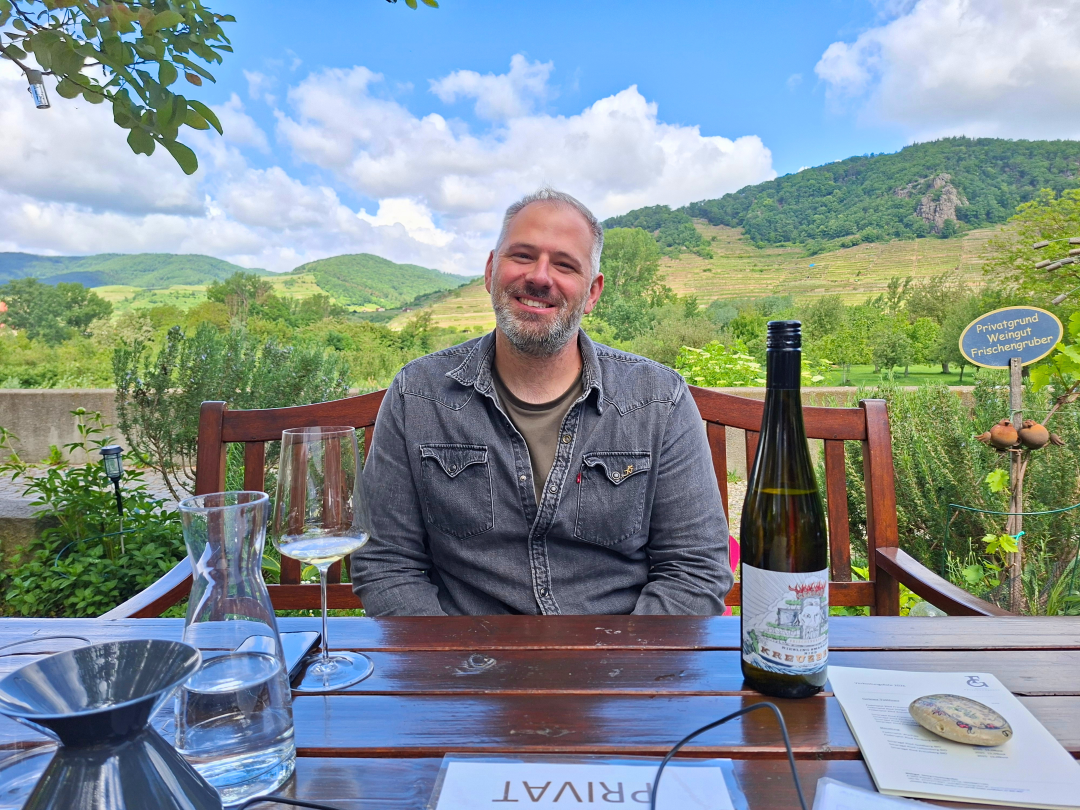
Georg Frischengruber in his garden on the southern bank of the Danube.
The Return of Rotundone
One of the most delicious results of the longer and slightly cooler growing season is the return of rotundone — the compound that brings such wonderful pepperiness to Grüner Veltliner, as well as other grape varieties like Syrah and Schioppettino. All the schoolbooks speak of Grüner’s pepperiness, and in the northerly Weinviertel, the aroma even has its own name: “pfefferl.” While I kept writing the word “savory” in so many of my tasting notes to describe that wonderful varietal Grüner expression of herbal, yeasty, salty umami, 2025 brought out the rotundone pepperiness that so many wine lovers seek. This characteristic of cooler weather/climate is alive and skipping in 2025.
A New Era of Pinot Noir in the Wachau
Over the years, I have tasted a number of Pinot Noirs from Lower Austria. Some are poetic and beautiful, clearly made by Pinot-obsessives, while others are much simpler but enjoyable, the kind of red wines one would expect in a region traditionally associated with white wine. Now in a changing climate, it is clear that Pinot Noir suits the local conditions. As I have argued elsewhere, when you plant a world-class variety in world-class sites, the results can be compelling. That said, Pinot Noir is not new here. For years, Emmerich Knoll has made a red Pinot Noir to be served at the family’s Loibnerhof Inn, which almost exclusively lists wines from the Knoll estate. Likewise, Pinot Noir has been a fixture at Jamek for quite some time, even though it is rarely showcased.
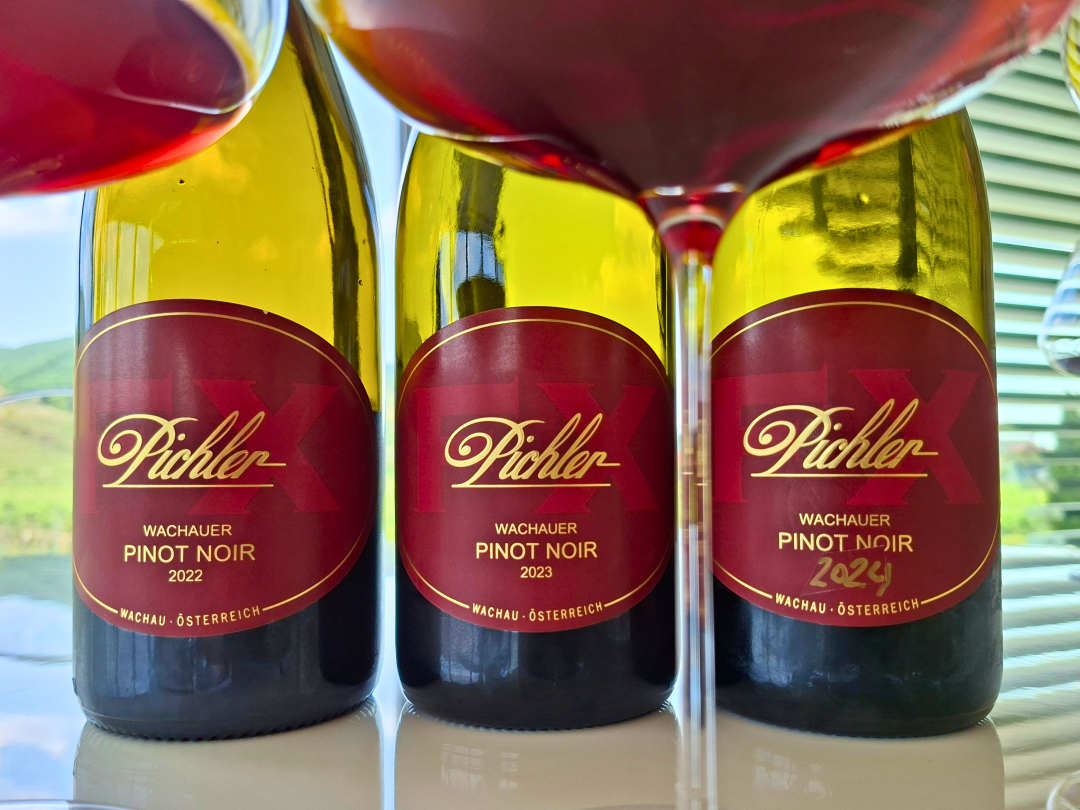
F.X. Pichler's Pinot Noirs, grown by Johanna and Lucas Pichler in the Wachau, represent years of work and an impressive debut.
What has changed now, with the debut of F.X. Pichler’s Pinot Noirs from the Wachau, is the level of ambition. Husband-and-wife team Lucas and Johanna Pichler are now seeing the results of their long-term project coming into fruition. In 2020, the Pichlers grafted over matured Pinot Noir vines and also planted new vines using massal selections from Austria and Burgundy, as well as Dijon clones. For this report, I tasted two finished Pinot Noirs from 2022 and 2023, as well as an early preview of the 2024. The wines are wonderful and show great potential for the variety here.
I tasted the wines in this report in Lower Austria in May 2026.
© 2026, Vinous. No portion of this article may be copied, shared or redistributed without prior consent from Vinous. Doing so is not only a violation of our copyright but also threatens the survival of independent wine criticism.
You Might Also Enjoy
2024 Burgenland and Austria's East: Heavenly Reds and Crisp Whites, Anne Krebiehl MW, February 2026
2023 Burgenland and Austria’s East: Gorgeous Reds, Aromatic Whites and Killer Sweets, Anne Krebiehl MW, March 2025
Sekt: Effervescent Germany and Austria, Anne Krebiehl MW, December 2025
2024 Wachau and Lower Austria: Calamities and Coups de Coeur, Anne Krebiehl MW, June 2025
2023 Wachau and Lower Austria: Mercurial Weather Gods Smiled in the End, Anne Krebiehl MW, July 2024
Show all the wines (sorted by score)
- Alzinger
- Bernhard Ott
- Bründlmayer
- Carmen & Herbert Zillinger
- Crazy Creatures
- Domæne Roland Chan
- Domäne Wachau
- Ebner-Ebenauer
- Emmerich Knoll
- Erich Machherndl
- Franz Hirtzberger
- Frischengruber
- Gerhard J Lobner
- Geyerhof
- Grabenwerkstatt
- Gritsch Mauritiushof
- Hirsch
- Hofkellerei des Fürsten von Liechtenstein
- Josef Jamek
- Jurtschitsch
- Lesehof Stagård
- Loimer
- Malat
- Markus Huber
- Martin Muthenthaler
- Nigl
- Nikolaihof Wachau
- Pfaffl R&A
- Pichler-Krutzler
- Prager
- Proidl
- Rudi Pichler
- Salomon – Undhof
- Schloss Gobelsburg
- Schlosskellerei Gobelsburg
- Weingut F. X. Pichler
- Weinhofmeisterei Hirtzberger
- Weinkultur Preiss KG
- Wess
- Wieninger
- Wine by Stefan Pratsch
- Zederbauer