
Browse using the new Vinous website now. Launch →
Printed by, and for the sole use of . All rights reserved © 2015 Vinous Media
2024 Burgenland and Austria's East: Heavenly Reds and Crisp Whites
BY ANNE KREBIEHL MW | FEBRUARY 5, 2026
Austrian growers south and east of Vienna, in the regions of Carnuntum, Thermenregion and Burgenland, had a marginally easier year than their colleagues to the west along the Danube. Most escaped the April frost and the flood events of September that affected Lower Austria so dramatically. Following record heat, many harvested earlier than ever before, but there is no lack of freshness in the resulting whites. When heavy rains came in mid-September, producers in the warmer east had already picked their fruit. The Blaufränkisch, Cabernet and Merlot that was still on the vines weathered the rain without any trouble, as grape skins were thick. Near Lake Neusiedl, clean and early botrytis arrived in late October, ensuring concentrated Ausbruch and TBAs.
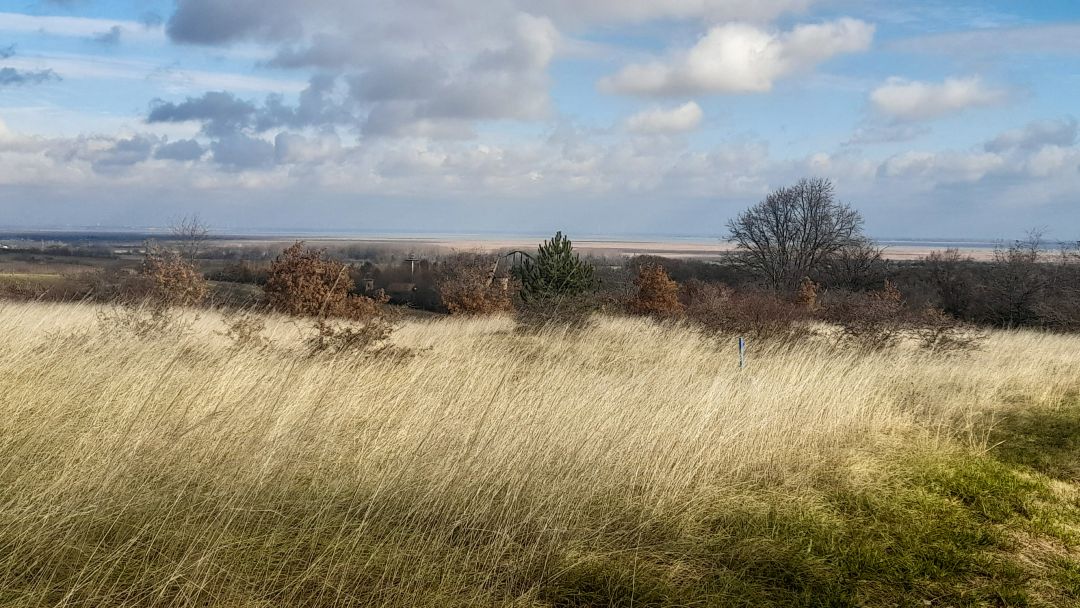
Looking west toward Lake Neuseidl.
Records Once Again
Introducing their 2024 Climate Status Report, the Austrian climate agency Klima- und Energiefonds noted, “Austrian regions lying below an altitude of 500 meters [i.e., the wine regions covered here], recorded around 90 summer days [defined as reaching 25°C and above], which is double the average.” Their regional report for Burgenland, open to the deep continental heat from Hungary’s Pannonian Plain, stated that 2024 was “the hottest year on record, by some margin.” The warmest March on record brought early budburst, but only a handful of growers (chiefly in the Thermenregion) sustained frost damage. In May, temperatures crept up again. Precipitation also kept up. April, May and June saw above-average rain, which meant that intense vineyard work was necessary to manage the vigorous canopy growth induced by warmth and sufficient water. Many growers reported disease pressure from Peronospora (downy mildew), which thrives in moist, mild weather. As of mid-June, a sustained dry phase set in, lasting until torrential downpours arrived in mid-September. This saw roughly double the average rainfall for the month across just a handful of soaking days, making it the wettest September on record. Temperatures that had been high throughout the dry period finally dropped when the rain came.
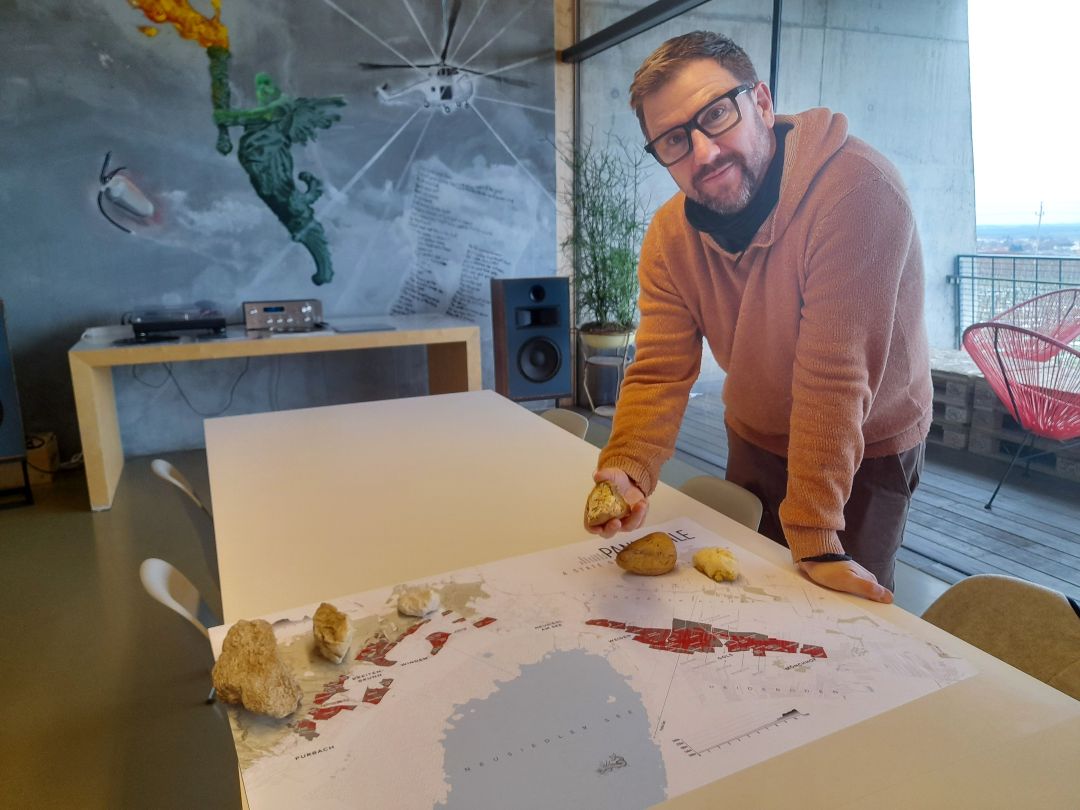
Claus Preisinger in Gols displays the different soil types of his sites surrounding Lake Neusiedl.
Learning to Deal with Extremes
Many growers cited their earliest harvest dates ever for 2024. However, if they were not hit by frost, grapes still had their usual hangtime. The early harvest did not thus lead to a curtailment of aromatic development. The moist spring also meant that few even mentioned dry stress, and nobody reported any trouble with sluggish ferments. While Christine Netzl said that her Grüner Veltliner clocked up a lot of sugar before it reached ripeness, Claus Preisinger did not make his usual Grüner Veltliner, and Hannes Schuster discarded some of his white wine. By and large, the whites—especially those from limestone sites—do not come across as hot or flabby. On the contrary, they are alive with freshness. This struck me especially about the wines from the slopes of the Leitha mountains, some distance from Lake Neusiedl, generally on the Tertiary Leitha limestone.
Winemakers have learned how to deal with the heat. Many mitigate lower acidities in white wines with whole-bunch pressing, i.e., whole, uncrushed bunches leach less potassium, buffering the pH less and making the wines seem fresher. The phenolics that, in the past, would have resulted from some skin contact now come via small additions of whole, destemmed berries in the ferment, or from portions of skin-fermented grapes. Other winemakers, like Pittnauer in Burgenland and Reinisch in the Thermenregion, harvest some fruit at the very cusp of ripeness to capture fresh acidity in order to have a blending component to add to the “regular” wine later. This adds freshness and vigor while mitigating high alcohol and moderate acidities. Red wines often benefit from portions of whole bunches in the ferment as well, lending lift and freshness. I asked some winemakers outright if they had acidified. The answer was always “no,” and I believe them.
Of course, the August picking dates meant that grapes were harvested in summer temperatures. Picking started either at or before daybreak and lasted only until midday at the latest. Taking advantage of the cooler morning hours was as important as getting the fruit to the winery quickly to prevent oxidation, which speeds up with the heat. For instance, Georg Prieler rented an additional tractor and trailer to facilitate instant transport. Others increased their teams and used cooling facilities and heat exchangers. Thanks to the dry weather leading up to harvest, fruit was in excellent health with little sorting necessary.
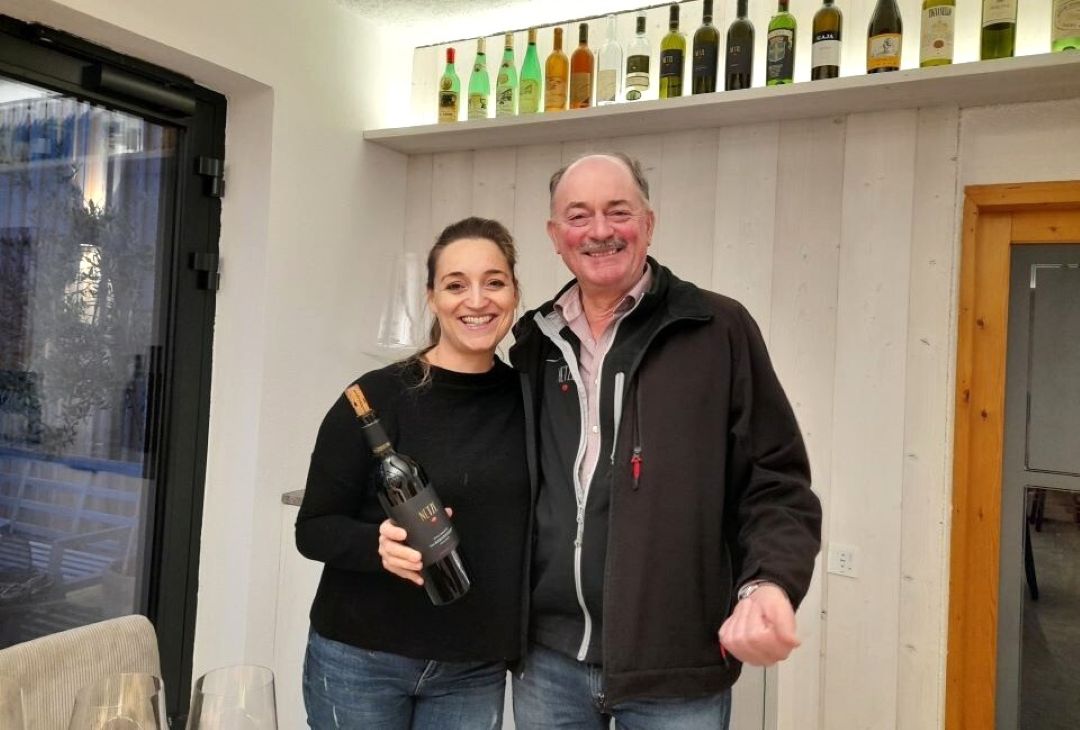
A wonderful father-and-daughter team—Christine and Franz Netzl in Carnuntum.
Indigenous Power
The real strengths of the regions are the indigenous varieties. Blaufränkisch is a marvel of a grape, always delivering acidity despite full ripeness. Georg Prieler in Burgenland, who made a riper and more powerful style of Blaufränkisch in the past, notes that the juice of mature Blaufränkisch vines never exceeds pH levels of 3.2 or 3.3, a figure that many red-winemakers can only dream of. Whether made as a tender Rosé, an extracted red or anything in between, this grape performs and shines with undoubted nobility and finesse. I prefer gentler extraction and whole-bunch-influenced ferments, which brings out the essential floral nature of this blue-fruited variety. Blaufränkisch did not suffer dry stress in 2024 and had thick skins, shrugging off September rain.
Sankt Laurent, Austria’s other indigenous red grape, also performs well in hot years. It simply does not clock up much alcohol, which explains the two distinct styles: the Pinot-esque fashion—scented, dark-fruited but essentially slender and sleek—and the powerful, almost jammy style where growers wait for grapes to shrivel to achieve higher alcohol levels, resulting in unbalanced wines. Thankfully, I did not encounter any of the latter in tasting for this report, as most winemakers now pursue freshness rather than power.
Where white varieties are concerned, more growers now embrace the indigenous Neuburger. Markus Altenburger in Jois, Burgenland, reports that Neuburger rarely suffers from dry stress and thrives in windy sites. Neither does it mind heat, which makes it a natural winner in Burgenland. Josef Umathum touts the moderate alcohol levels of the Hungarian Hárslevelű, a name he prefers to the grape’s German name, Lindenblättriger. The local white heroes of Thermenregion, Rotgipfler and Zierfandler, thrive. More and more winemakers wax lyrical about Furmint. Once part of Burgenland’s heritage, which only became Austrian in 1921, Furmit was not replanted in the region until 1986, when Robert Wenzel reintroduced it in Rust. The variety’s ability to retain acidity and tolerate both heat and drought while still making chiseled wines has converted many. Wenzel’s son Michael makes some hair-raising examples. Meanwhile, Hannes Schuster of Weingut Rosi Schuster has top-grafted 40-year-old Pinot Blanc to Furmint. The 2023/2024 Austrian grape statistic only shows 35 hectares of Furmint, but this will grow. As for the international “everywhere” grape that is Chardonnay, in the right hands, it turns out stunning, fresh, enduring wines.
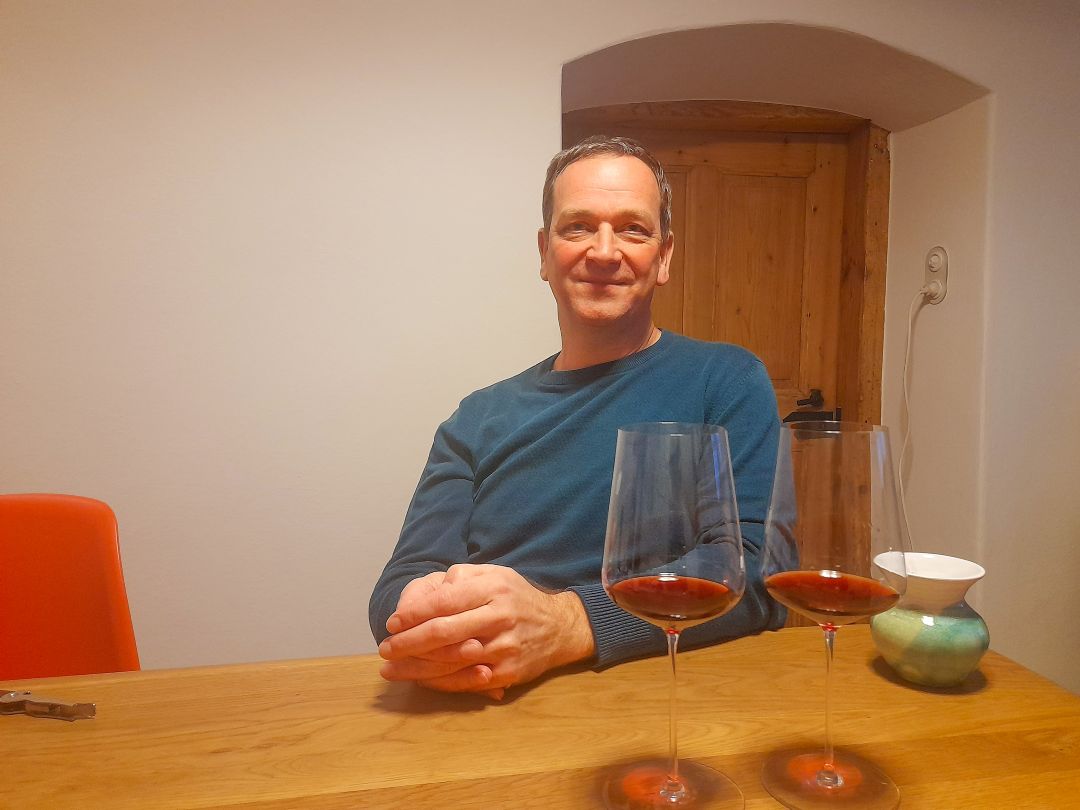
Michael Wenzel in Rust. Like their maker, Wenzel's wines are thoughtful, inquisitive and boundary-pushing.
A Word on Pinot Noir
The deeply continental heat of Burgenland tends to be too much for Pinot Noir—only a mere handful of growers attempt it, and even fewer succeed in bringing out its essential elegance. Despite this, there are 241 hectares of Pinot Noir in Burgenland. Its spiritual home in Austria, however, is the much smaller Thermenregion, with just 113 of Austria’s total 603 hectares of Pinot Noir. Pinot Noir lovers should know that while there may be little Pinot Noir in Austria, some of it is world-class, and Thermenregion is the place to look.
Many of the red wines in the report are from the 2023 and 2022 vintages. Despite the heat of 2022, the wines show no excess weight. The 2023 vintages is shaping up as a red rival to the stunning 2021.
I tasted the wines in this report during estate visits in late November 2025.
© 2026, Vinous. No portion of this article may be copied, shared or redistributed without prior consent from Vinous. Doing so is not only a violation of our copyright but also threatens the survival of independent wine criticism.
You Might Also Enjoy
2023 Burgenland and Austria’s East: Gorgeous Reds, Aromatic Whites and Killer Sweets, Anne Krebiehl MW, March 2025
Sekt: Effervescent Germany and Austria, Anne Krebiehl MW, December 2025
2024 Wachau and Lower Austria: Calamities and Coups de Coeur, Anne Krebiehl MW, June 2025
2022 Burgenland and Austria’s East – A Heaven for Unsung but Compelling Reds, Anne Krebiehl MW, February 2024
2023 Wachau and Lower Austria: Mercurial Weather Gods Smiled in the End, Anne Krebiehl MW, July 2024
Show all the wines (sorted by score)
- Alex Koblinger Prieler
- Alphart am Mühlbach
- Andi Kollwentz
- Birgit Braunstein
- Claus Preisinger
- Dorli Muhr
- Esterházy
- Hans & Anita Nittnaus
- Heidi Schröck & Söhne
- Heinrich Hartl
- Johanneshof Reinisch
- Josef Umathum
- Markowitsch
- Markus Altenburger
- Michael Wenzel
- Moric
- Moric/Hidden Treasures
- Netzl
- Paul Achs
- Pittnauer
- Prieler
- Rosi Schuster
- Sohm & Kracher
- Stadlmann
- Tinhof
- Weingut Kirchknopf
- Weingut Velich
- Weinlaubenhof Kracher