
Browse using the new Vinous website now. Launch →
Printed by, and for the sole use of . All rights reserved © 2015 Vinous Media
Give Me Five: South Africa New Releases
BY NEAL MARTIN | OCTOBER 20, 2026
Wednesday, August 12
Time to escape England's tropical heat and cool down in Africa. That sentence alone is a measure of how topsy-turvy weather systems are right now. After padlocking my suitcase, a lightbulb goes off in my head: pack something warm, you idiot. I grab the nearest thing to hand — my “Vin et Hip Hop” hoodie, both cool and warm. Exiting Cape Town airport 12 hours later, and mercifully just one time zone further along my circadian rhythm, all above is blue sky. The temperature is a degree above balmy. This is winter, right? No complaints. But I soon discover this unseasonal warmth is giving winemakers furrowed brows.
Ronnie, my driver for many years, greets me with a beaming smile and announces he is “ready to rumble,” one of several catchphrases. Minutes later, we are driving past the sprawling Cape Flats township, population two million and rising, a permanent reminder that hardship is never far. We arrive at the hilltop residence of la grande dame, Wendy Appelbaum, at DeMorgenzon. She and I shoot the breeze before tasting on the front lawn. The challenge is to ignore the panoramic views towards the distant Helderberg mountains that stop Stellenbosch’s vineyards from running away. I could return home now with just that view tucked in my pocket. On second thought, that might annoy a few winemakers.
From there, a short drive to Reyneke for a joint tasting with Donovan Rall. Both “Tall Rall” and Johann Reyneke wax lyrical about the 2025 vintage that unfolded trouble-free across the entire Cape, mercifully absent heat spikes and delivering cool nights that locked in acidity. Even yields are around 10 to 12% above those of 2024. Perhaps like Bordeaux and Burgundy, vintages in South Africa ending in five tend towards greatness. Indeed, Rall remarks that it was the easiest vintage since 2015. Winemakers are still rubbing their eyes at their good fortune. Someone must have snapped a One Wish Willow.
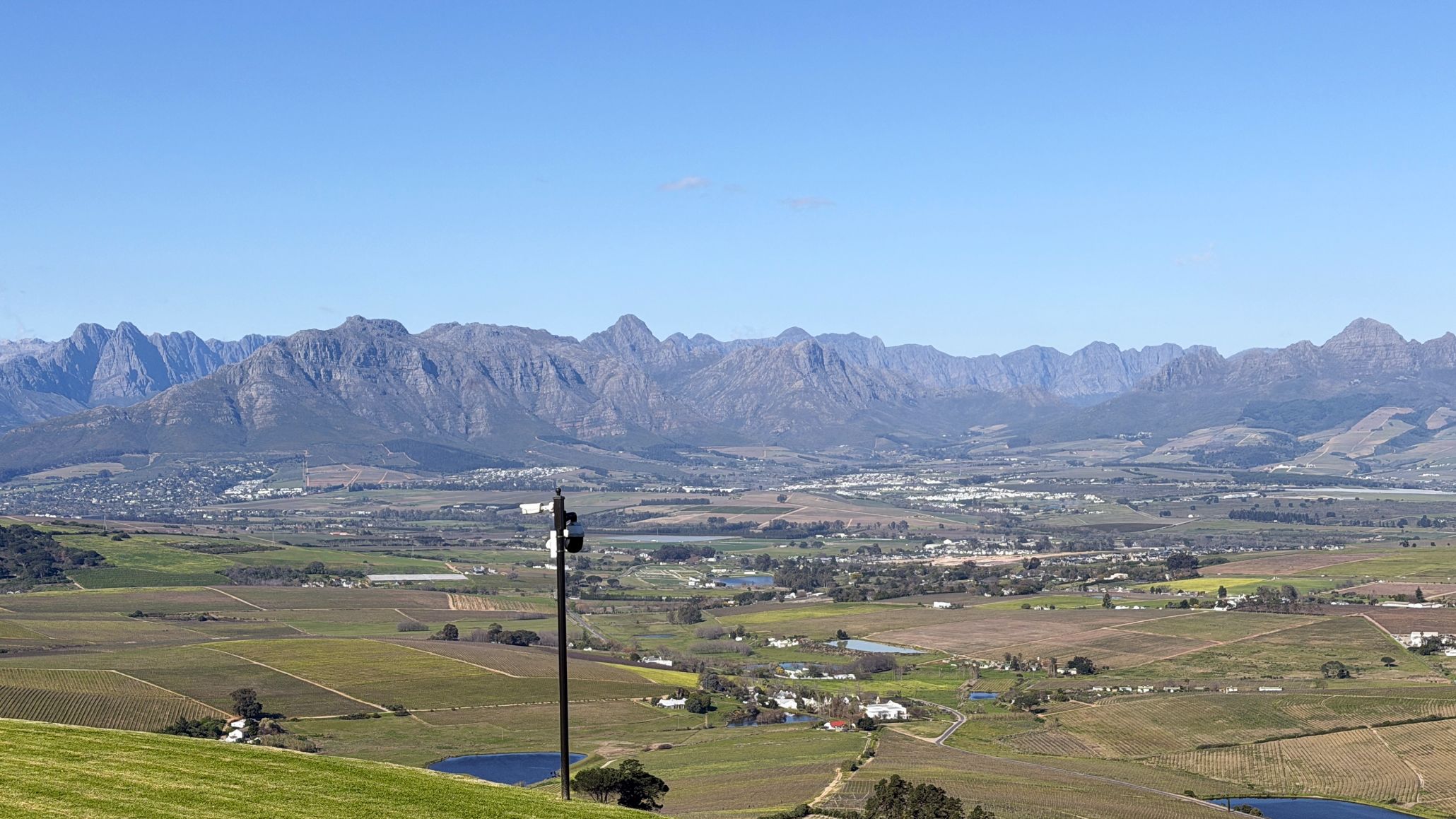
Looking over Stellenbosch towards the Helderberg peaks from DeMorgenzon.
Thursday, August 13
Hey, you know that thing I mentioned… a trouble-free growing season? Well, in early 2026, Breedekloof suffered severe flooding, damaging a vital bridge that is closed to vehicles for the foreseeable future. So, I am perplexed when we park outside a dishevelled convenience store. Are we going shopping? Instead, I am invited to walk across the bridge for another winemaker to complete the second leg, thus avoiding a 32-km detour. It is a logistical nightmare for local winemakers transporting fruit around the region. Imagine if the RN74 in Burgundy were suddenly blocked.
Hiding behind a mountain range, Breedekloof has historically been a less-well-known wine region. Its profile is on the rise, in lockstep with improving wines that reach their apogee with Ferdi Visser’s scrumptious range at Olifantsberg. Her Grenache Blanc is outstanding — not the first time this variety has made my taste buds happy. Alas, consumers tend to queue for familiarity, gravitating toward Chardonnay or Sauvignon Blanc and eschewing white Mediterranean varieties. Grenache Blanc is one of several isohydric grape varieties whose stomata close when temperatures climb too high, halting evapotranspiration and keeping a lid on sugar levels — an asset in South Africa. Eben Sadie and I have discussed this subject, and he kindly sent an abstruse biochemical explanation that I am still decoding. Anyway, this underscores why fellow isohydric variety Chenin Blanc prospers, why others like Assyrtiko, Clairette, Grenache and Cinsault are gaining popularity and perhaps why regions elsewhere, hidebound to permitted varieties under appellation rules, might need to bend them as global warming reconfigures everything.
Since we are all agreed that five is the lucky number, here are five Grenache Blancs in this report to seek out:
- · 2024 Olifantsberg Grenache Blanc (Breedekloof)
- · 2025 Scions of Sinai Gramadoelas (Klein Karoo)
- · 2025 Rall Wines Grenache Blanc (Piekenierskloof)
- · 2025 Brookdale Grenache Blanc (Paarl)
- · 2025 Momento Grenache Blanc (Western Cape)
After an obligatory team winemaker photo, it is back to the broken bridge. I drop in at David Finlayson, where we briefly discuss leafroll virus. Some used to countenance leafroll, even citing its benefits in terms of tempering ripeness levels. These days, most growers undertake the only means of ridding the virus: removing whole parcels to rule out infection. Whether this practice is affordable is another matter. Finlayson has removed around 20% of his vines; he tells me leafroll affects those on clay soils more than those on gravel. After I taste his latest vintage, Finlayson generously opens an ancient bottle from his father Walter’s stash. Last year, it was the 1968 Cabernet Sauvignon GS. This year, he opens a 1949 Full-Bodied Burgundy from Stellenrood, one of the oldest Cape wines to ever pass my lips. Its iridescence augurs a postwar wonder. Still savouring that faux-Burgundy, it is a short drive to Kanonkop, where a new chapter is opening under Winemaker Dirk van Zyl. We could not meet this time, but I wish him all the best for the future.
The evening finishes chez Bruwer Raats. His wines are exceptional, as anyone who attended Vinous Icons: New York can attest. Raats is obsessed with two things: vines and rugby. Next weekend, the South African Springboks take on New Zealand’s formidable All Blacks. The entire future of the country hinges on the result… at least that is how it feels. Raats is cautiously optimistic. Then again, we tasted together during the Springboks’ infamous defeat by the minnows of Japan, a result I promised never to mention. Ever.
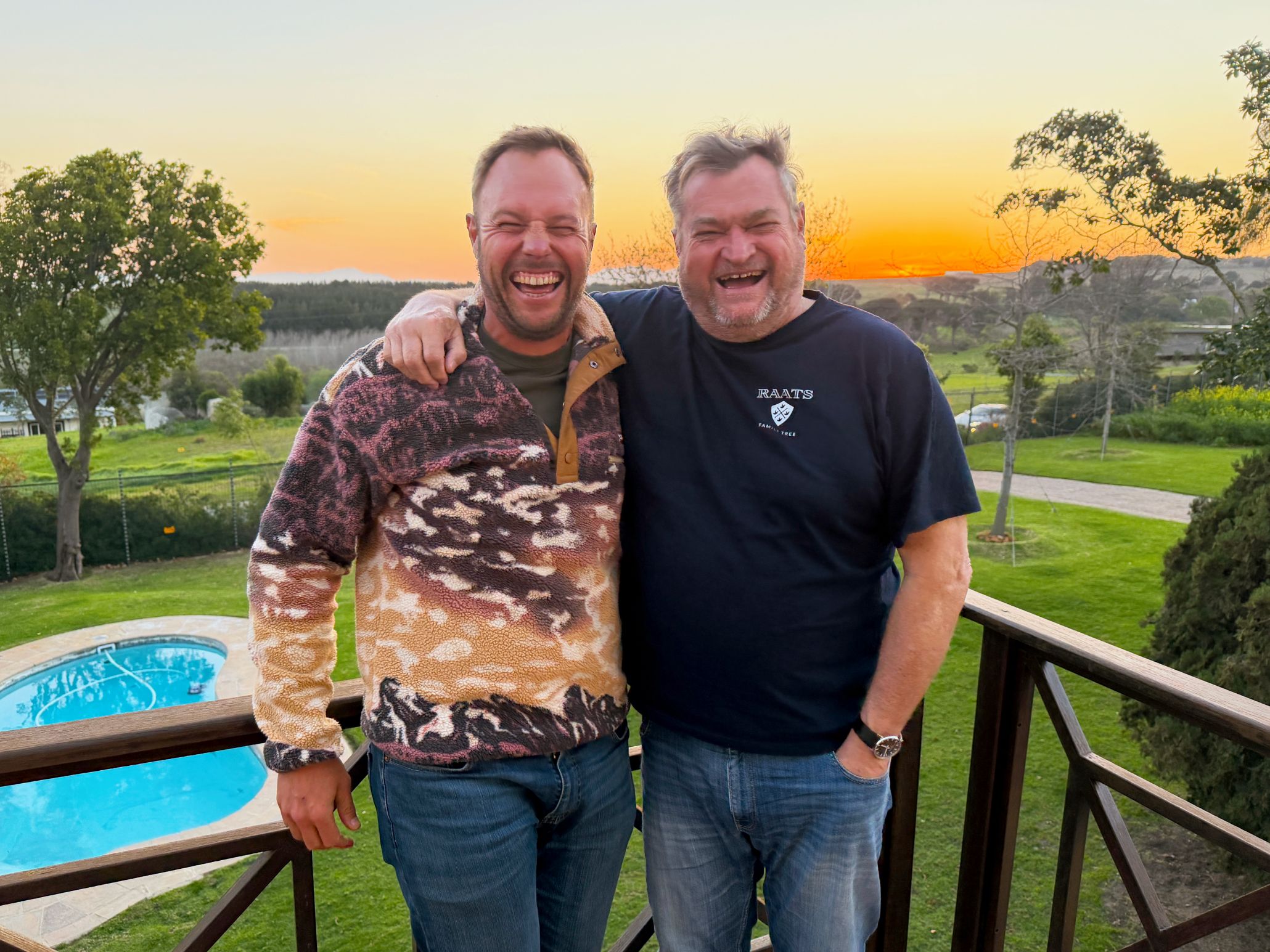
Bruwer Raats (right) with Gavin Bruwer Slabbart (left), whose sweater is available in all charity shops.
Friday, August 14
Every day starts with granola. It is my morning fix. It sounds fussy, but you must look after your health. No croissants. No pastries. Fruit ‘n nuts are my fuel. Alas, my accommodation serves the muesli equivalent of “Yellowtail,” and so each morning, I slip out of the reception pretending to have an urgent breakfast meeting and devour the “DRC” granola at the hotel opposite.
Franschhoek beckons. Boekenhoutskloof aside, this region still needs to pull its socks up. You could accuse it of treading water since it can rely on a steady influx of tourists who, let us be frank, are not as discerning as your average Vinous reader. Most simply want a fermented souvenir. Fortunately, things are gradually changing, especially as pockets of ancient vines come under the guardianship of skilled winemakers. Most notable of these is a three-hectare parcel of Semillon planted in 1905, the foundation of outstanding wines from the likes of Ian Naudé and Eben Sadie. After another inspiring tasting with Reenen Borman at Boschkloof, I meet 29-year-old winemaker Léhandri Bothma, who has just taken the helm at Glenelly. At the beginning of her career, she was inspired by a speech given by May-Éliane de Lencquesaing. Now the 101-year-old erstwhile owner of Pichon Comtesse de Lalande is her boss. Kismet.
Saturday, August 15
Parkrun. No ifs, no buts. Keep an eye on your body and your body will look after you. This morning’s run is around the vines at Meerendal in Durbanville Hills. The clue is in the name — it is a bit “up and down.” Alas, my plan to take a mid-run photo of the view is nixed by thick fog. I freshen up at nearby winery Groot Phesantkraal, then take an impromptu detour to Remhoogte, one of many estates whose wines are more elegant and finessed than in the past. Owner Murray Brousted tenured with the late Michel Rolland in Pomerol, which inevitably influenced Brousted’s wines, though he has now returned to his father’s style: less ripeness and plushness, greater sense of place. That is a common trend across Cape reds, not least in Stellenbosch. Mirroring Saint-Émilion in some ways, Stellenbosch is home to what can be described as both “traditional” style and “modern” style, with some like Raats straddling the two and others like Vergelegen transitioning between them. Here are five of what I would call great “traditionalist” Stellenbosch reds:
- 2021 Kanonkop Wine Estate Paul Sauer
- 2021 Remhoogte Cabernet Sauvignon Reserve
- 2024 Tokara Pinotage Limited Release
- 2022 Kaapzicht Steytler Vision
- 2022 Jordan Wine Estate Sophia
Next, I meet with Miles Mossop, a winemaker who is either in the vines or riding the surf, accompanied here by three feisty hounds that leap all over me. Henceforth, all winery dogs sniff their canine friends’ odour and my “Vin et Hip Hop” hoodie begins to smell like a kennel. The view from Mossop’s patio is breathtaking and again, I mentally fix blinkers as I attach words to his wines. I finish the day with Lukas van Loggerenberg and a dog so enormous that it has its own gravitational pull. Midway through the tasting, his cat jumps onto my lap, and immediately my hoodie is covered with fur that will excite more dogs. I am walking catnip.
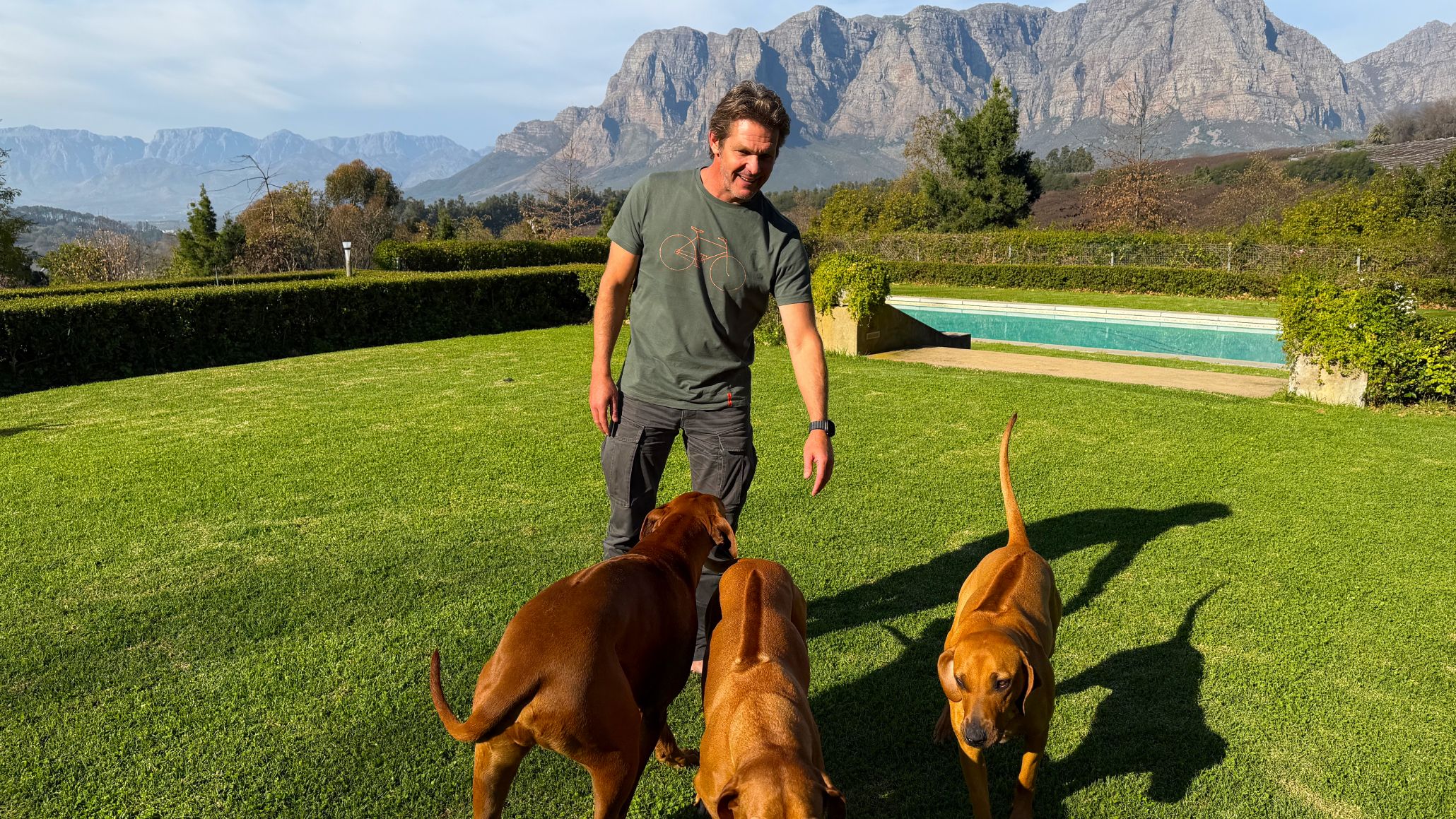
Miles Mossop in his back garden. The dogs are Rhodesian Ridgebacks, a breed common among wineries because of their protective instincts.
A warm-up match for next week’s titanic tussle with the All Blacks plays on TV in the background. Van Loggerenberg is a little concerned about his home team’s prospects next weekend. He should have no concerns about the prospects for his fermented grape juice.
Sunday, August 16
Constantia, ahoy! After tasting at Constantia Glen, we drive into Cape Town to taste the latest releases from Klein Constantia, plus a handful of Sauvignon Blancs that have orbited the sun a few times. I meet winemaker Matt Day at Revolution Records instead of the winery. The slightly bemused record shop owner asks what album to play in the background, and I select Jordan: The Comeback by Prefab Sprout — nothing to do with the namesake Stellenbosch winery. Suffice it to say that Klein Constantia’s mellifluous Vin de Constance is as pure as singer Paddy McAloon’s vocals. South Africa’s dessert wines can come from botrytised grapes or, more commonly, from grapes dried on straw. Here’s a quintet worth seeking out:
- 2023 Klein Constantia Vin de Constance (Constantia)
- 2025 Groot Phesantkraal Noble Late Harvest (Durbanville Hills)
- 2025 Keermont Vineyards Fleurfontein (Stellenbosch)
- 2025 Miles Mossop Kika (Stellenbosch)
- 2025 Mullineux Straw Wine (Swartland)
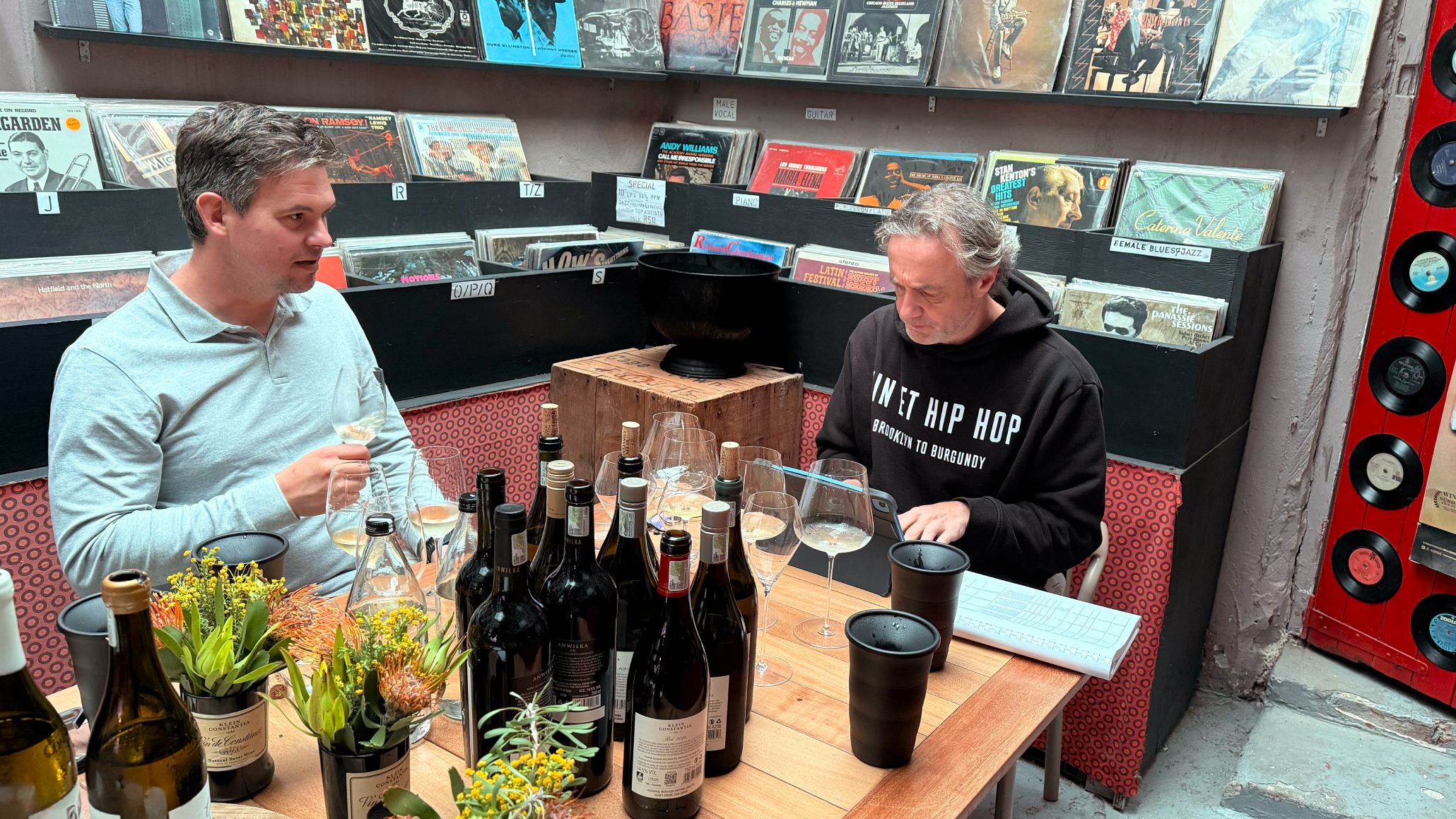
Tasting with Matt Day at Revolution Records.
After lunch, I scoot around the corner to taste with Duncan Savage. He is an unofficial ringmaster, having arranged for over 40 members of the Cape Winemakers Guild to travel en masse to Johannesburg for the rugby match and cheer the Springboks to victory. This “school trip” symbolises the collectivism that, to my mind, uniquely characterises South African winemaking fraternity — friendships formed at Stellenbosch or Elsenberg universities that down the line foster the constant exchange of ideas, collaboration and support. And you need that in these parts.
I finish the evening at The Fat Butcher with Luke O’Cuinneagain of Vergelegen, an estate that, like Remhoogte, pursues a different style compared to a decade ago and has slimmed down their range, another welcome trend. O’Cuinneagain generously brings a bottle of Vosne-Romanée to the bistro. Our bushy-tailed sommelier treats it like the Holy Grail. Not wishing to burst his enthusiasm, I suggest it is streets behind many of his compatriot Pinot Noirs. He ignores me. It is Burgundy and, therefore, untouchable.
Monday, August 17
I start the week with one of Stellenbosch’s brightest stars, Bernhard Bredell at Scions of Sinai. Given the nonstop schedule, you must seize the slimmest of openings to leap into vineyards, so I hop into his bakkie to inspect a parcel of the Chenin Blanc bush vines that form his Granietsteen cuvée. The parcel upslope that snuggles up directly behind a row of wild fynbos is the source for Chris Alheit’s Nautical Dawn cuvée. It makes me think… Many think of South African wineries like large, Bordeaux-like estates, and while those exist, it is apposite to view contemporary South Africa like Burgundy, where landowners rent propitious parcels to various growers. Like Burgundy, there is constant buying and exchanging of fruit that fuels the churn of new, young winemakers who could never afford to buy land. That underlies the kinship with the Côte d’Or. God forbid; next you’ll be telling me that South African winemakers are making Burgundy.
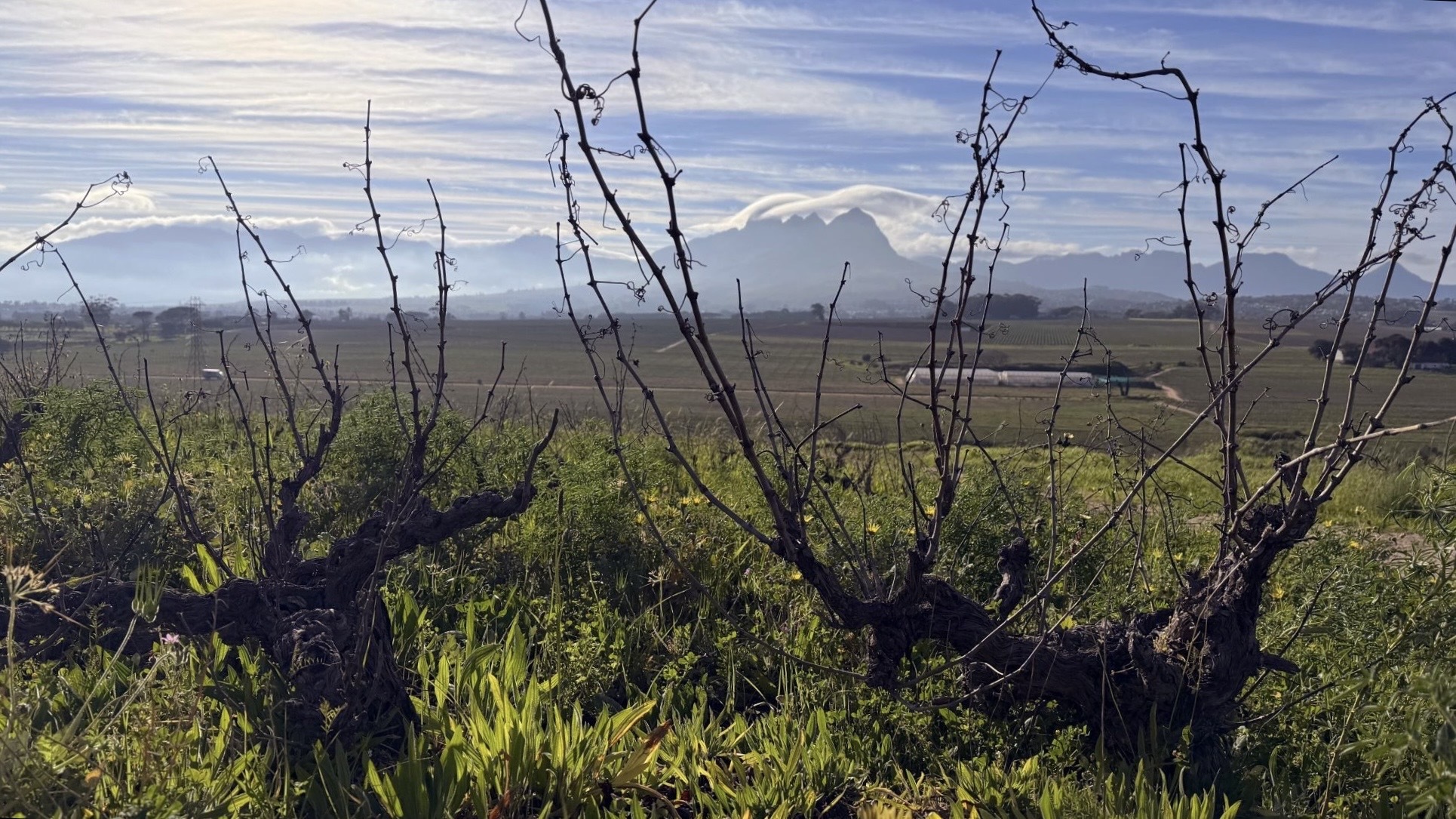
Old Chenin vines getting ready to bud around three weeks earlier than usual at Scions of Sinai.
After this, an intense but fruitful tasting at Gabrielskloof, not just the wines of Peter-Allen Finlayson (Crystallum) but also Thorne & Daughters, Beaumont and Momento, whose Tinta Barocca came to my rescue when searching for a decent wine that would not require an IMF loan at Row On 5. Nevertheless, Winemaker Marelise Niemann explains that it is a tough sell, again because of consumers’ trepidation. Tinta what?
Then, another hour’s drive west to Stanford for my second joint tasting with the Cape South Coaster collective. These producers exist on the eastern viticultural frontier, part of the country that feels like open and untouched swathes of fynbos. These mostly young winemakers are connected by a low-intervention ethos both in vineyard and winery. Here are my top five:
- 2024 Brunia Wines Syrah
- 2024 Brunia Wines Hinterlands
- 2025 Saurwein Pinot Noir Nom
- 2024 Thamnus Wines Chardonnay
- 2024 Van Niekerk Wines Rebellie
After a barbecue, I am chauffeured back to my accommodation out in the middle of nowhere. Disorientated by darkness, it takes a quarter of an hour to work out my bearings and find my room. I did not fancy sleeping rough and being eaten by the mountain leopards that roam these parts.
Tuesday, August 18
I wake up to find a tray of granola on the kitchen sideboard. Ticks all the boxes. Let’s go. First stop, Chris Alheit in the Hemel-en-Aarde valley, the baby-faced genius winemaker who fills me in on the latest goings-on at Hemelrand Farm. As we talk about pressing matters, I admire his label artwork. As I mentioned in this year’s Beaujolais report, never underestimate the importance of a label. We live in a world where looks count. Alheit’s labels belong in a gallery. Bordeaux, with its uniform and too often indistinguishable labels, could take a leaf out of South Africa’s book. Stylistically, Alheit’s wines are more about nuance and texture than obvious fruit; they can be difficult to understand young and warrant cellaring. Here are five producers whose wines lean towards that style:
- Thorne & Daughters (Western Cape)
- Rall Wines (Swartland)
- David & Nadia (Swartland)
- Momento (Bot River)
- Sadie Family Wines – Old Vine Series (Swartland)
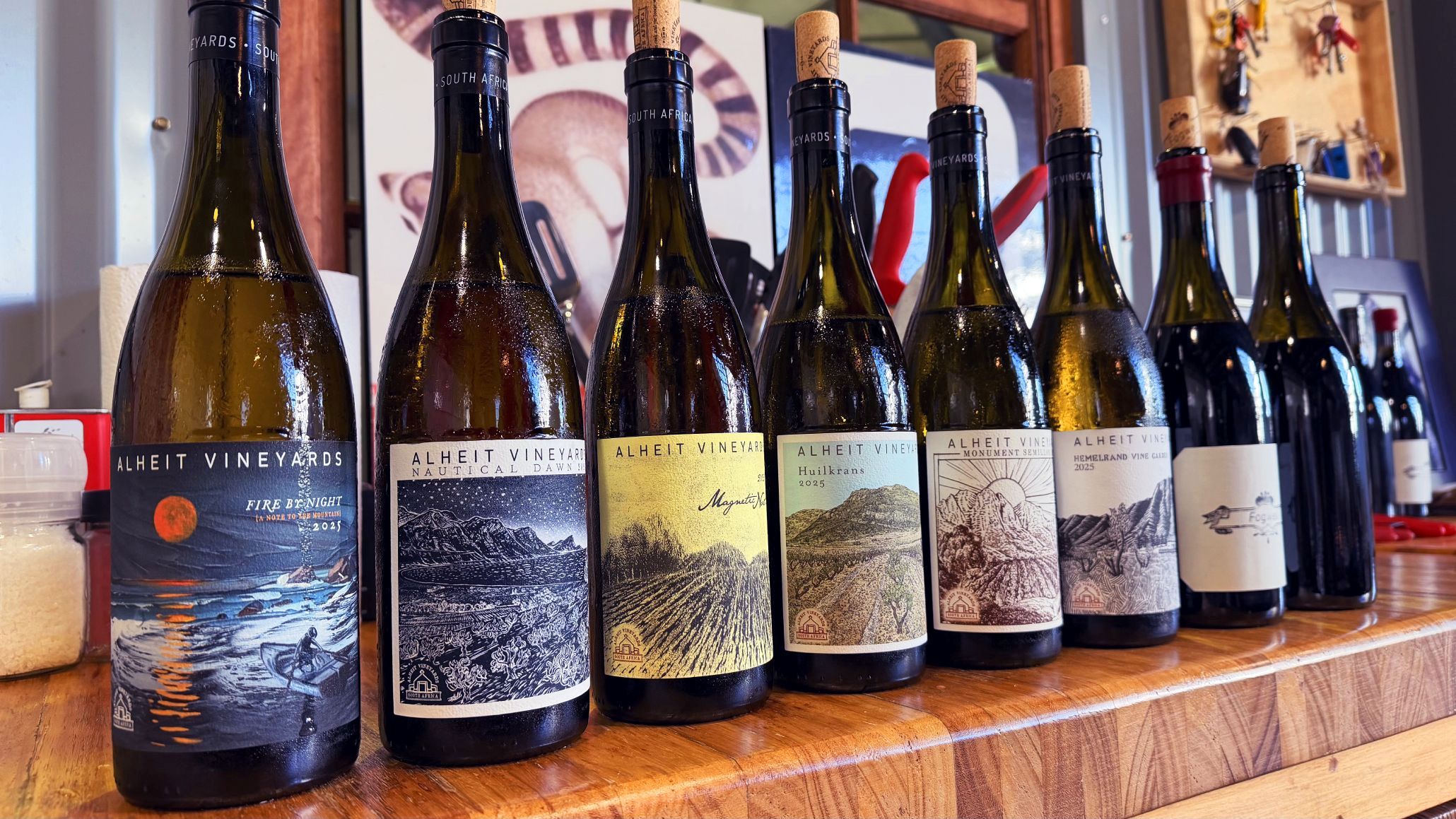
Exquisite labels adorn Alheit’s site-reflective cuvées.
After tasting at Restless River, where another couple of dogs consider me for breakfast, my next stop is Storm Wines. I have pronounced several times that South Africa produces world-class wine. I put that to the test a few weeks before my trip at a blind tasting in London of South African wines pitted like-for-like against renowned French producers — First Growths, Grand Crus and so on. Hannes Storm’s 2021 Pinot Noir Ridge was in the ring with a 2021 Bonnes-Mares from a superb grower. David and Goliath? Nobody could tell which cost almost £500 and which cost £50. That is no slur against Burgundy, rather a vindication of what Hannes Storm is achieving. The choice of what consumers buy is theirs.
Here are five compelling South African Pinot Noirs:
- 2025 Crystallum Cuvée Cinema (Hemel-en-Aarde)
- 2023 Richard Kershaw Pinot Noir Deconstructed Kogelberg Sandstone PN777 (Elgin)
- 2024 Storm Wines Pinot Noir Ridge (Hemel-en-Aarde)
- 2025 Tesselaarsdaal Wines Pty Pinot Noir (Hemel-en-Aarde)
- 2024 Beeskamp Pinot Noir Single Vineyard (Elgin)
Storm is a self-confessed Burgundy lover and opens one additional bottle to conclude our tasting — his own 2023 Clos Vougeot. Yes, that Clos Vougeot, home of the Chevaliers du Tastevin and various rappers hyping the crowd. The Grand Cru is delicious. Alas, just 300 bottles and so far, the only vintage. The day finishes at Creation Wines, where I enjoy a wonderful healthy meal (at least until the chocolate dessert arrives). The restaurant at Creation, like several others, is hugely successful, a people magnet. Diners can soak in the landscape whilst they subconsciously form a bond with the winery. Even Adi Badenhorst recently introduced a pizza night where you can spot your favourite Swartland producer demolishing a Sloppy Giuseppe.
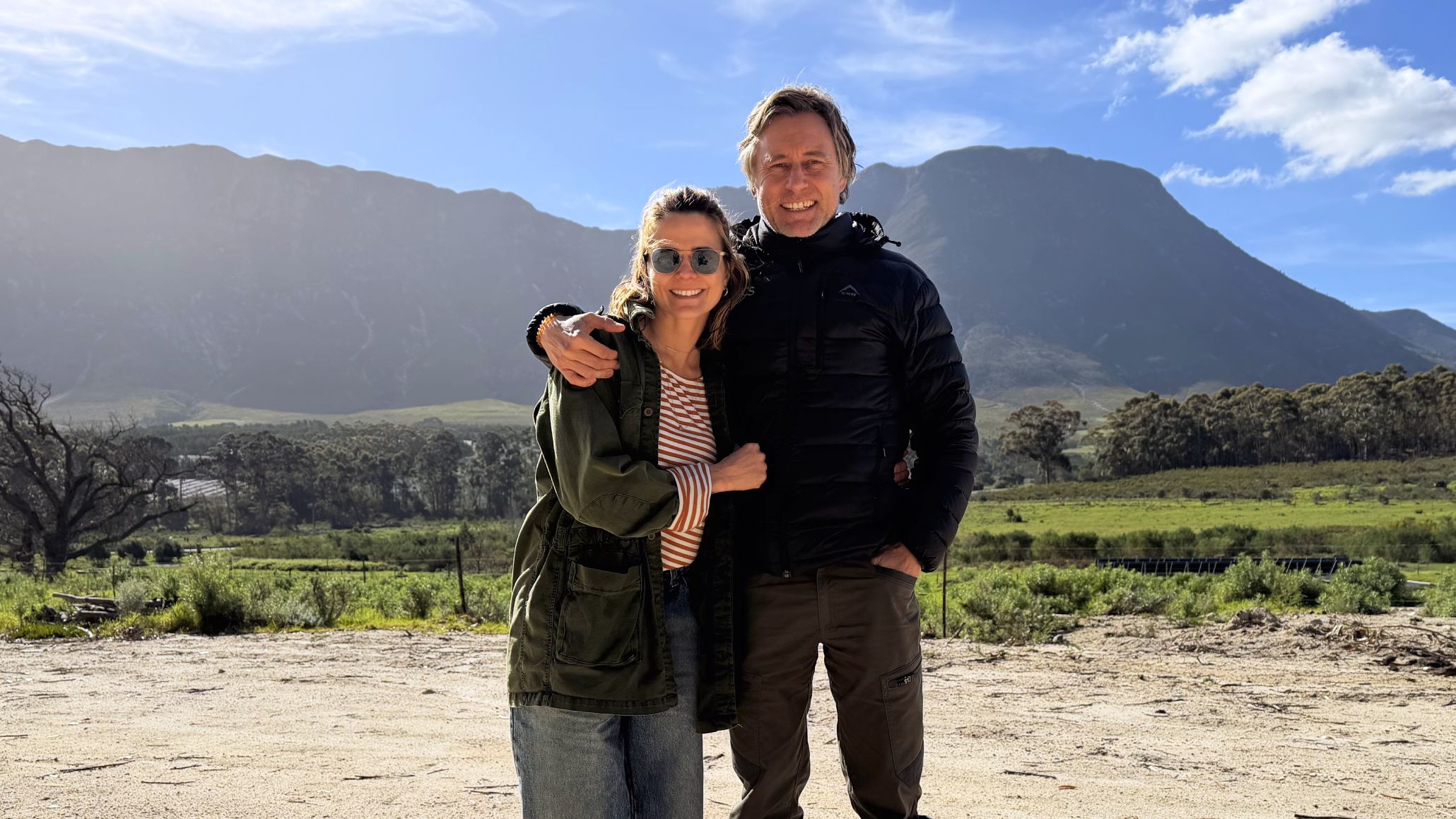
Winemakers Hannes and Nathalia Storm in Hemel-en-Aarde.
Wednesday, August 19
The day begins with the smartest man in the Cape (sartorially rather than cerebrally), Anthony Hamilton-Russell, guarded by his Great Dane who is the size of a horse. It lollops towards me with a deafening bark and, in slow motion, deposits approximately a magnum’s worth of slobber over the sleeve of my beleaguered hoodie. Thanks. Anyway, it is a great tasting with the O.G. of Hemel-en-Aarde, winemaker Emul Ross, plus Berene Sauls of Tesselaarsdal, one of a small but growing number of black female winemakers in the Cape. Her son has also >been bitten by the wine bug and is gaining experience at Domaine Dujac in Morey-Saint-Denis. Diversity and representation in the wine industry is a topic that I have broached in previous reports —it is especially important in a country still struggling with racial division.
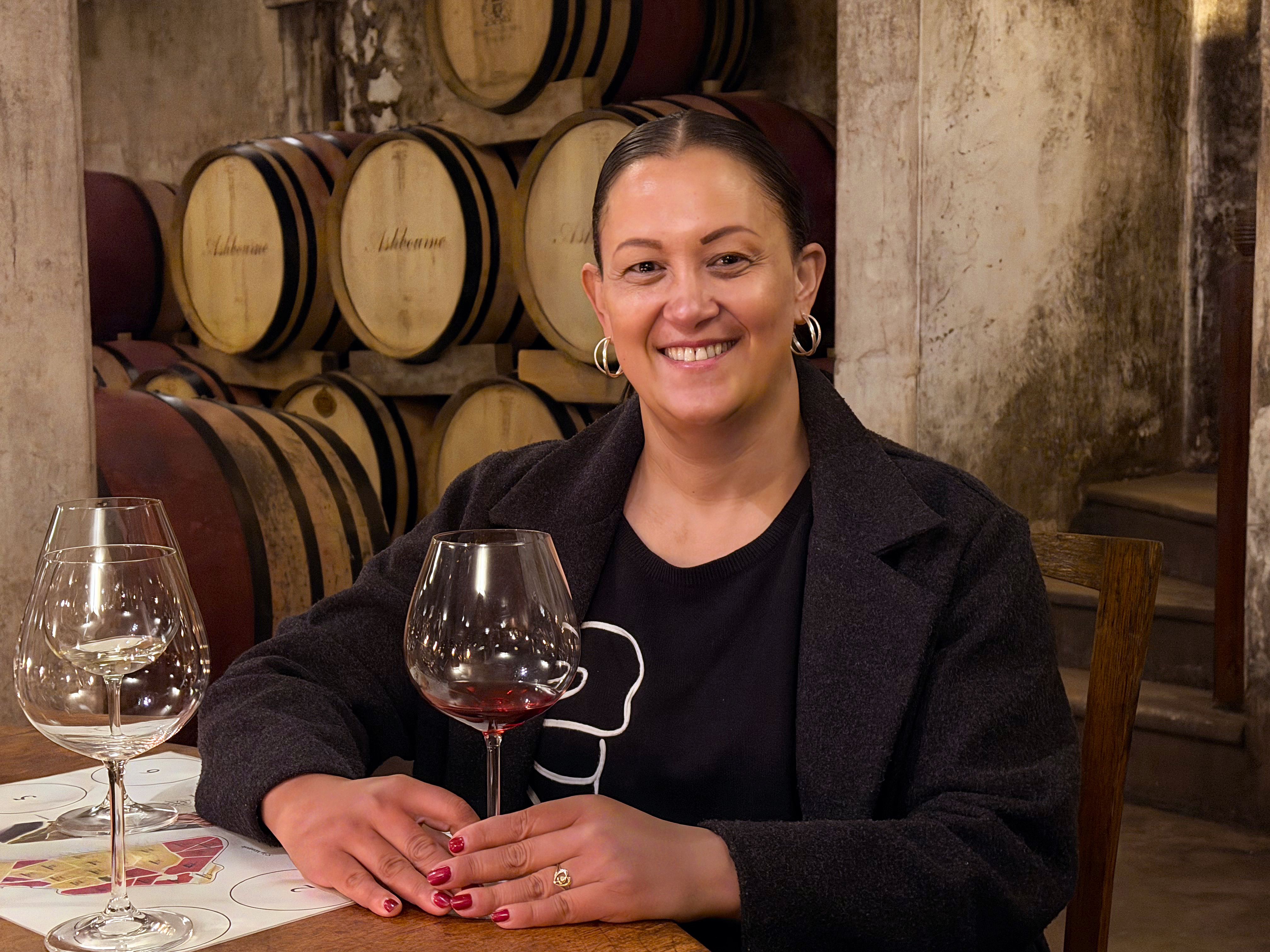
Berene Sauls of Tesselaarsdal Wines pictured at Hamilton Russell.
I make a long overdue return to Iona Wines in Elgin, where unfortunately I have about 20 seconds to wolf down a delicious homemade venison tagliatelle due to miscalculating my schedule. I then pay visits to Damascene Wines and Richard Kershaw, whose office is so beige it looks like a scene from Backrooms. The day finishes at Tokara. Afterward, a second visit to The Fat Butcher, where I must be the first customer to order vegetarian. Thankfully, I am not marched off the premises.
Thursday, August 20
Swartland! I rub the sleep from my eyes at an ungodly hour — it is a 90-minute drive to meet Andrea Mullineux at Roundstone Farm. She is to wine what Amelia Earhart was to aviation. No ocean too wide. One such ocean crossed was her successful campaign for the International Organisation of Vine and Wine (OIV) to officially recognise Semillon Gris as a grape variety instead of a mutation. It only took 14 years. Passing the mother block, we stop to inspect the vines, where Mullineux explains how Semillon Gris’ pigmentation differs; it’s more like a red variety, ergo, it can ripen more quickly. Henceforth, you will see it on labels in South Africa and elsewhere.
It is just a short drive to see Adi Badenhorst at Kalmoesfontein Farm. Turkish musician Mustafa Ozkent blares from a gramophone so that Badenhorst’s gestating wines are maturing to great music. We taste together in his office, home to a menagerie of stuffed birds taking flight above his bureau to create a Dickensian-cum-mad professor vibe. Badenhorst’s slimmed-down range is now more focused, starting from his commercially successful Secateurs cuvées to single-site bottlings with tongue-twisting Afrikaans names.
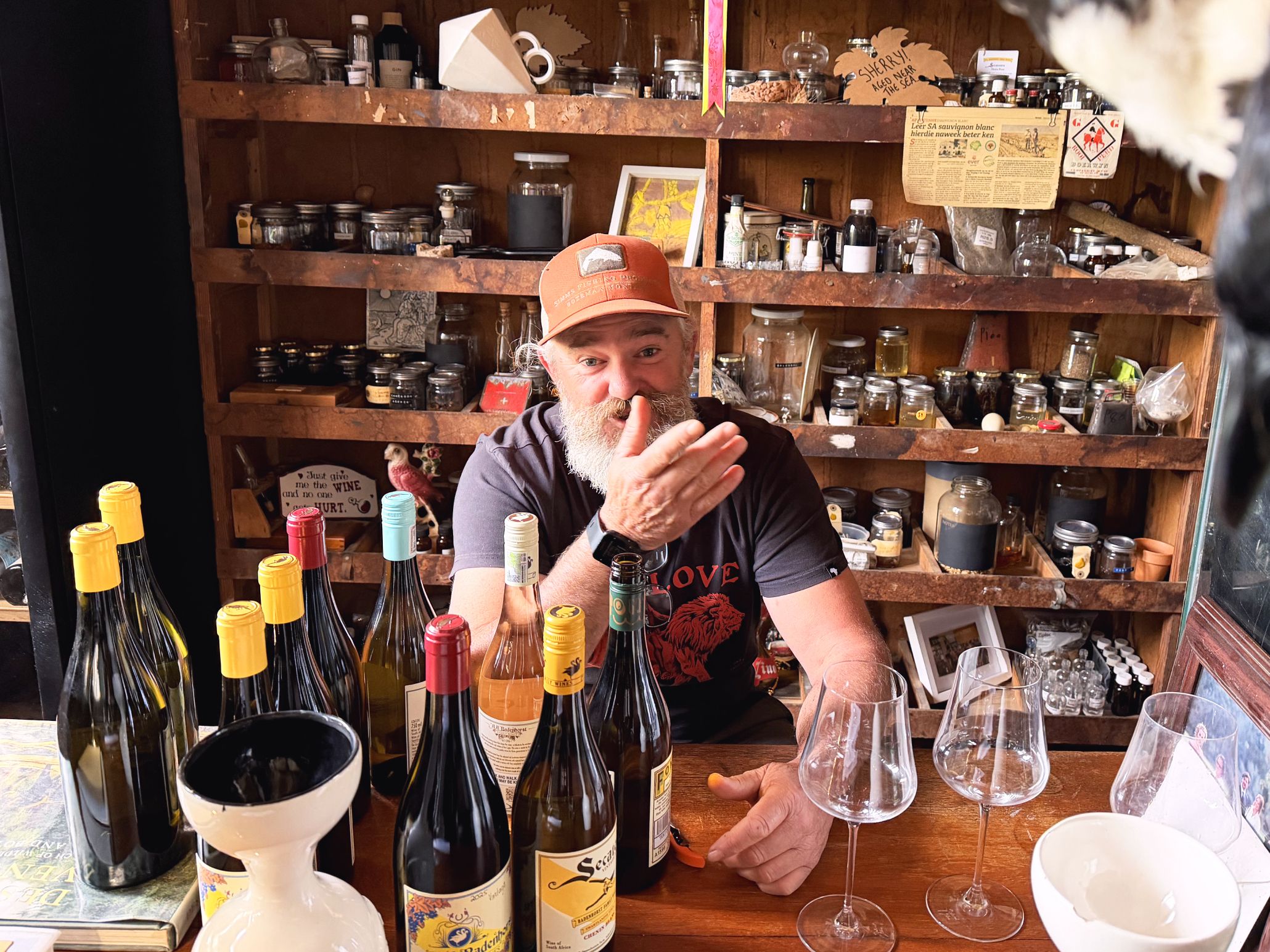
Tasting with Adi Badenhorst in his office with one of his feathered friends.
After tasting at David & Nadia Wines, I undertake a lengthy tasting of assorted Swartland producers, rudely interrupted by a power outage. For a moment it might have continued by the light of an iPhone, though an outside generator eventually whirrs into action, as if it has seen it all before.
The most interesting discovery here is Zwartwater. These wines come from the Lammershoek estate, next to Eben Sadie. In recent years, Zwartwater fell off the radar. That is about to change under new owner Stefan Johannes, who clearly has the bit between his teeth and is determined to restore the estate’s fortunes. Lammershoek is home to some of Swartland’s finest terroir and already acts as a wellspring of prized fruit for several notable cuvées produced by others. Johannes tells me that they will continue to sell some of their fruit on the condition that it is not blended with fruit sourced from outside the estate. This will be an interesting story to follow, as the two wines presented here bode well for the future.
Friday, August 21
Back to Stellenbosch for tastings at Kaapzicht, Stark-Condé and Le Riche before returning to my hotel for a tasting with Lismore’s Samantha O’Keefe. Readers may already be aware of the wildfire that devastated much of her vineyard, winery and homestead. It has taken years to really compartmentalise that trauma. O’Keefe explains how the respected pruning team from Simonit are working to secure the long-term viability of the damaged vines. She is one of the winemakers cheering the Springboks to victory tomorrow, and she shows the special necktie she and the others will be wearing for the occasion, which must surely pose a challenge for several winemakers who assumed they would never need one after leaving junior scho
The day concludes with winemaker Abrie Beeslaar, who will join tomorrow’s rugby school trip, so I make sure we finish early. I am taken by his Pinotage, which leans into its Pinot Noir heritage rather than Cinsault, an exemplar of refinement and sensuality, the antithesis of your typical Pinotages commonplace just a few years ago. The variety used to be the butt of jokes. Now, winemakers are refashioning the variety to suit contemporary tastes. Here are five to hunt down and rethink your preconceptions:
- 2023 Ashbourne Pinotage (Hemel-en-Aarde Valley)
- 2024 Beeslaar Pinotage (Stellenbosch)
- 2022 Kaapzicht Pinotage Steytler (Stellenbosch)
- 2025 Scions of Sinai Féniks (Stellenbosch)
- 2025 Wolf & Woman Wines Pinotage (Swartland)
Saturday, August 22
Parkrun, part II. I return to Paarl and shave 30 seconds off last year’s time. Ronnie has dusted off his trainers and “run.” I use that word in an even looser term than “Full-Bodied Burgundy,” since I could have written my entire report waiting for him to cross the line. I freshen up at Brookdale, who have provided what can only be described as the Romanée-Conti of granola. This puts me in good stead to taste with Xander Sadie (son of Eben Sadie). Brookdale’s field blends continue to inspire, though Sadie is introducing varietal bottlings when deemed fit.
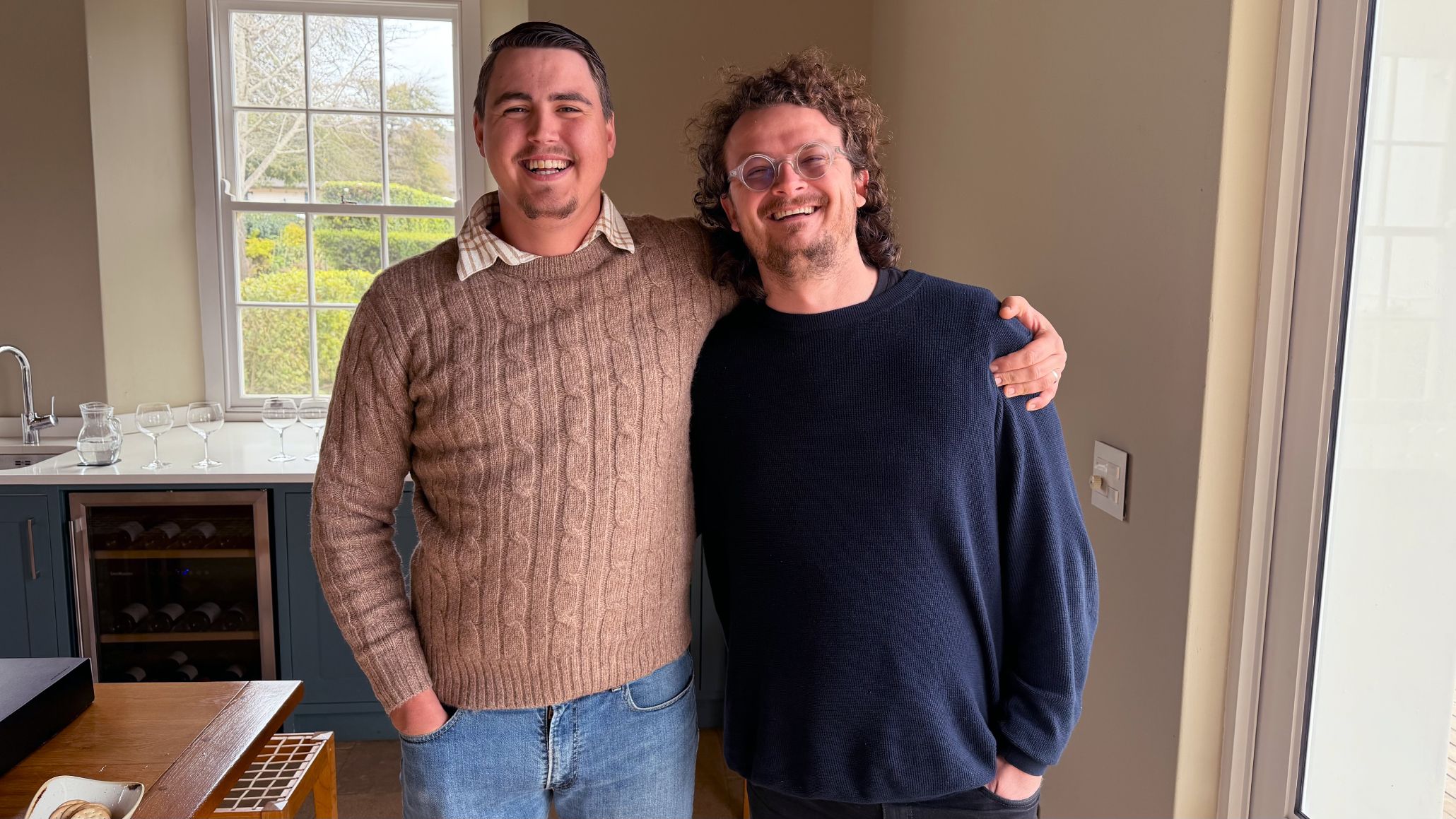
Xander Sadie of Brookdale with Sam Lambson of Minimalist Wines.
After dropping in to see Shawn Mathyse at Ken Forrester Wines, we drive to Alex Starey at Keermont. Starey’s family have gathered to watch the Springboks meet their destiny with the All Blacks. Chris Mullineux joins; his “Amelia Earhart” is somewhere in the stands. Mullineux brings a lovely half-bottle of 1982 Edelkeur Noble Late Harvest from Nederberg. The referee blows the whistle. We are off! The play is as balanced as one of Keermont’s exquisite Syrahs. Alas, during the half-time break, the Springboks forget how to hold a rugby ball. Their performance is so dire that nobody bothers watching them lose 33-16. (South Africa eventually wins the series against the All Blacks, three games to one.) Even Andrea Mullineux cannot do anything.
We braai under a light drizzle. The rain is welcome, given the unseasonal dryness over the last three months. Memories of drought remain fresh in winemakers’ minds. At least presently, reservoirs are fuller, 79% compared to 50% when the last drought began and eventually came close to leaving people without running water. H2O management will be a major topic in the future: floods one minute, drought the next. How do you adapt to a climate with such extremes? Of course, winemakers here are allowed to irrigate. Unlike in Europe, many wineries are already equipped with private reservoirs to preserve this increasingly precious commodity.
Sunday, August 23
To cast the net as wide as possible, today is dedicated to tasting wines submitted by producers I have not had time to visit. In some ways, the lineup is a truer reflection of South African wine, since there’s no cherry-picking producers. Make no mistake, there are exceptional wines and new discoveries in the mix. Here are five standouts:
- 2023 Peter Ferreira Extra Brut Cap Classique Birdsong (Franschhoek)
- 2025 Lourens Family Wines Chenin Blanc Mathias Single Vineyard (Piekenierskloof)
- 2025 Thistle & Weed Chenin Blanc Brandnetel (Stellenbosch)
- 2024 Trizanne Signature Wines Syrah TSW (Swartland)
- 2025 Hazendal Wine Estate White Blend (Bottelary Hills)
Winemaker Ian Naudé and I meet in the evening. Though he has been through a rough patch, he is on the mend, with that permanent smile and infectious laughter intact. Naudê2 blithely explains how he sometimes spends hours in that aforementioned parcel of Semillon planted in 1905. He just sits and admires the gnarled vines. His Semillon is indeed wonderful, though his Cinsault is the one that blossoms and entrances. Cinsault can seem a bit fey compared to broad-shouldered Cabernet or Syrah, but it has a proclivity to gain substance and complexity with aeration. Here are five to get your hands on:
- 2025 Savage Wines Follow The Line (Darling)
- 2024 Leeu Passant Cinsault Wellington Old Vines Basson (Wellington)
- 2025 Badenhorst Family Wines Cinsault Rangmuur (Swartland)
- 2018 Naudé Family Wine Co Cinsault Werfdens (Darling)
- 2024 City On a Hill Song of Ascents (Swartland)
Monday, August 24
Final day. I meet irrepressible winemaker Banele Vakele. Brought up in the Khayelitsha township, Vakele became entranced by vines outside his classroom window at school. He graduated from Elsenberg (whose alumni include Eben Sadie), spent three years with Duncan Savage (where we first met) and now flies solo with Tembela Wines. Tembela means “hope” in Xhosa and is also the name of Vakele’s late mother. He is a beneficiary of the CWG Protégé Program. Vakele has a glint in his eye and brims with entrepreneurial chutzpah — crucial for his enterprise to stand on its own feet. We inspect his Cabernet bush vines, a forthcoming joint project with Savage. Vakele tells me that families walking by sometimes reach out to eat the bunches. In a place where food on a plate cannot be taken for granted, hanging fruit is seen as a gift from God instead of farmer’s produce. There is a more ominous threat than a few lost bunches. This parcel is part of the large Steynrust Eendrag Farm that leases vines to several winemakers. Located next to the coastal urban area of Somerset West, the landowners have received lucrative offers to sell this prime piece of real estate. Vakele mentions two adjoining farms that recently sold to investors and instantly deprived winemakers of fruit. To rub salt into wounds, the land is currently in limbo. This is not the only example. Swathes of the Cape’s oldest, most precious vines already fell victim to bulldozers. Thanks in part to the renaissance in South African wine and safeguarding initiatives such as the Old Vine Project, many hectares were saved. These sites are the bedrock of some of the most vaunted wines in this report, yet the threat will never abate.
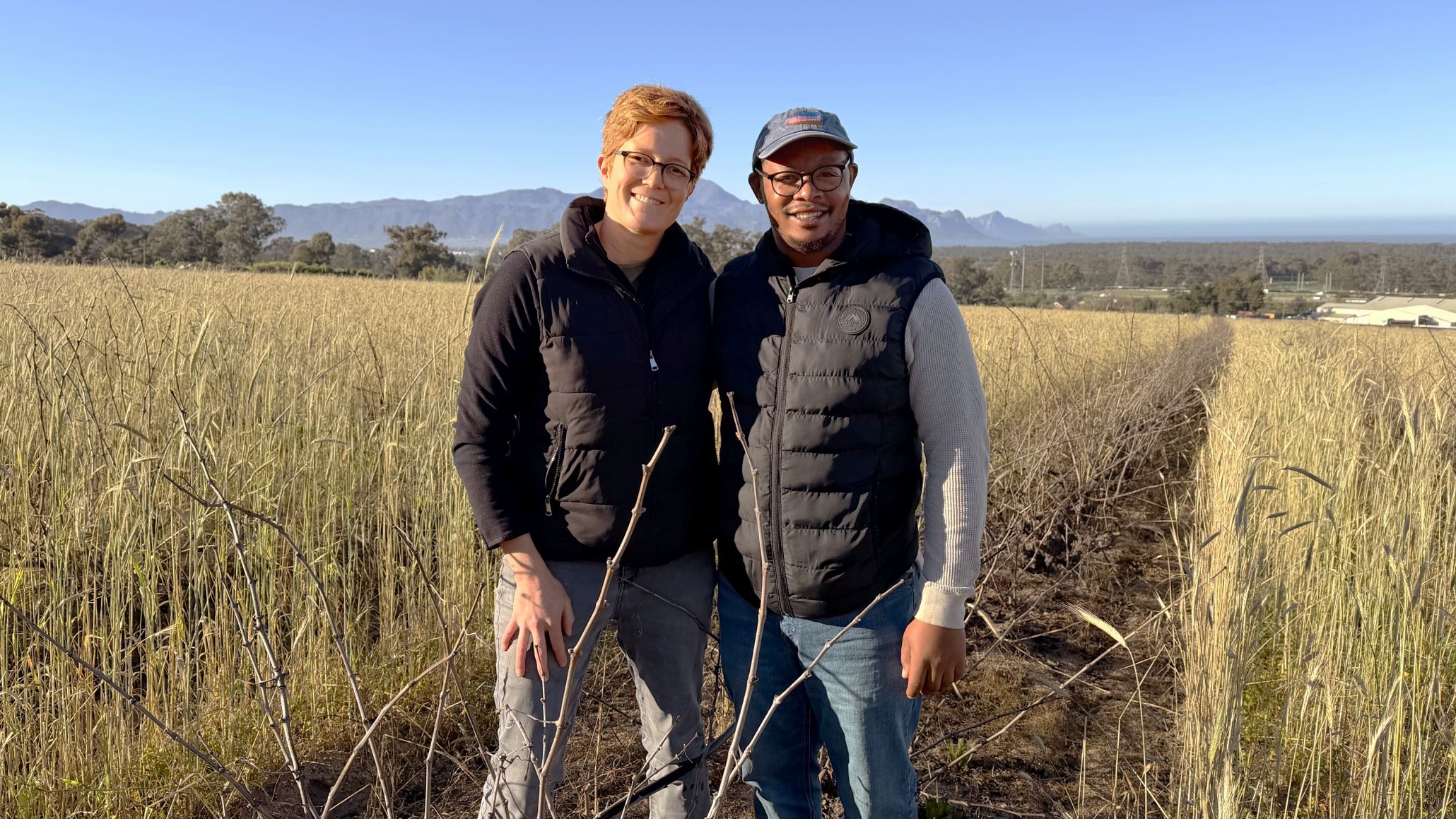
Winemaker Banele Vakele of Tembela Wines (right) with Cato Steyn (left), whose family owns tracts of prime vineyard currently outsourced to several well-known and very grateful winemakers.
Afterwards, there is a lunch and tasting with Mike Ratcliffe of Vilafonté, one of the most successful South African brands in the States. Their entry-level Seriously Old Dirt saw a fourfold increase in sales in no small part due to a snappy, memorable name, just like Chocolate Block. How many buyers realise which country it comes from? Does it matter? Conversely, some of the tongue-twister Afrikaans names, as much as I personally adore them, risk stymying demand because consumers fear embarrassment mispronouncing the name. After my final stop at De Grendel, I defeat the laws of physics, wedging half-a-dozen bottles into my suitcase. I need a fork-lift to carry it. I pray none of them break, lest my entire wardrobe stink of Chenin Blanc for several weeks. On second thought, that is not such a bad thing. At least my hoodie will not smell of cats and dogs.
Time to fly home. The Cape always leaves indelible memories that alter me in a positive way — maybe more world-wise and more appreciative of the comfort I grew up in. Waiting to board, I list five reasons why now is the time to delve into South African wine:
- That rarest of commodities: affordability.
- The dazzling array of styles — the Cape polymath.
- The Cape's finest winemakers are pushing the boundaries of viticulture and winemaking.
- The countless stories behind the charismatic men and women behind the labels.
- Sheer deliciousness.
That’s just five. Taste for yourself and add your own.
© 2026, Vinous. No portion of this article may be copied, shared or redistributed without prior consent from Vinous. Doing so is not only a violation of our copyright but also threatens the survival of independent wine criticism.
You Might Also Enjoy
Cape Winemakers Guild: 2026 Auction Wines, Neal Martin, September 2026
Day by Day: South Africa in 2025, Neal Martin, October 2025
South Africa: Where Are We Now?, Neal Martin, September 2024
The A to Z of South Africa, Neal Martin, November 2023
Growing Up ‘n Getting Wiser: South Africa in 2022, Neal Martin, September 2022
Show all the wines (sorted by score)
- Alheit Vineyards
- Alto Wine Estate
- Ampersand
- Angus Paul Wines
- Anthonij Rupert Wyne
- Anwilka
- Ashbourne
- Ataraxia
- Avondale Wine
- Avontuur
- Backsberg Family Wines
- Badenhorst Family Wines
- Beaumont Family Wines
- Beeslaar
- Belle Rebelle Estate
- Bellevue
- Bellingham Wines
- Benguela Cove Estate
- Bergsig Estate
- Blaauwklippen
- Black Elephant Vintners
- Black Pearl Wines
- BLANKBottle
- Boekenhoutskloof
- Boschendal Wines
- Boschkloof Wines
- Bosman Family Vineyards
- Brocha
- Brookdale
- Brunia Wines
- Bruwer Vintners Vine Exploration
- Capensis
- Cape of Good Hope
- Cap Maritime
- Carinus Family Vineyards
- Cavalli
- City On A Hill
- Constantia Glen
- Creation Wines
- Crystallum
- Damascene
- Daschbosch
- David & Nadia
- Deep Rooted Wines
- De Grendel Wines
- Delaware Graff Estate
- Delheim
- DeMorgenzon
- Diemersdal
- Du Bois Vineyards
- Du Toitskloof Wines
- Edgebaston Vineyard - David Finlayson Wines
- Eight Gates Wine
- Electric Mud
- Ernie Els Wines
- Fogwell
- Fryer's Cove
- Gabriëlskloof
- Genevieve
- Glenelly Estate
- Great Heart
- Groot Phesantekraal
- Hamilton Russell Vineyards
- Hartenberg
- Hartenberg Estate
- Hazendal Wine Estate
- Hearth Wines
- Iona
- Jason's Hill
- Jordan Wine Estate
- Journey's End
- Kaapzicht
- Kanonkop Wine Estate
- Kara Tara
- Keermont Vineyards
- Ken Forrester Wines
- Klein Amonskuil
- Klein Constantia Estate
- Klein Graniet
- Kloovenberg
- La Grande Domaine
- Le Chant Wines
- Leeu Passant
- Leeuwenkuil Family Winery
- Le Riche
- Lismore Estate Vineyards
- L'Ormarins
- Lourens Family Wines
- Maanschijn
- Meerlust Estate
- Merwida Wines
- Miles Mossop
- Minimalist Wines
- Momento
- Mountain Ridge Winery
- Moya Meaker
- Mullineux
- Mvemve Raats
- Natte Valleij
- Naudé Family Wine Company
- Newton Johnson Family Vineyards
- Off The Record Wines
- Oldenburg
- Old Road Wine Co.
- Olifantsberg
- Opstal Wines
- Org de Rac
- Orpheus and the Raven
- Paulus Wine Co.
- Pieter Ferreira
- Porseleinberg
- Raats Family Wines
- Rall Wines
- Remhoogte
- Restless River
- Reyneke Wines
- Richard Kershaw Wines
- Riebeek Valley Wine Company
- Roundstone
- Rust en Vrede
- Saga Vineyards
- Sakkie Mouton Family Wines
- Salt Rock Wines
- Saurwein Wines
- Savage Wines
- Scions of Sinai
- Soldana
- Southern Right
- Spier
- Stark-Condé
- Steilpad
- Storm
- Swartland Winery
- Taaibosch
- Tembela Wines
- Tesselaarsdal Wines Pty
- Thamnus Wines
- Thelema Mountain Vineyards
- The Sadie Family Wines
- Thistle and Weed
- Thorne & Daughters
- Tokara
- Trizanne Signature Wines
- Van Loggerenberg Wines
- Van Niekerk Vintners
- Van Wyk Family Wines
- Vergelegen
- Vilafonté
- Vulpes Wines
- Warwick
- Waterford Estate
- Waterkloof
- Wightman and Sons Wine Co.
- Winshaw Vineyards
- Wolf & Woman Wines
- Yellowwood Winery
- Zwartwater