
Browse using the new Vinous website now. Launch →
Printed by, and for the sole use of . All rights reserved © 2015 Vinous Media
.Châteauneuf-du-Pape 2025: Powerful Reds, Precocious Whites
.BY NICOLAS GREINACHER | OCTOBER 1, 2026
Tradition runs deep in Châteauneuf-du-Pape, but so does change. My latest tastings revealed an appellation poised between two very different vintages: the elegantly austere 2024 and the solar, powerful 2025. In addition, white Châteauneuf-du-Pape reached a record share of the appellation’s production in 2025, driven by a renewed emphasis on freshness and a fascinating diversity of varieties, soils, blends and philosophies. This report explores that evolution, identifies benchmark whites, revisits the bottled 2024 reds and offers a first glimpse of 2026.
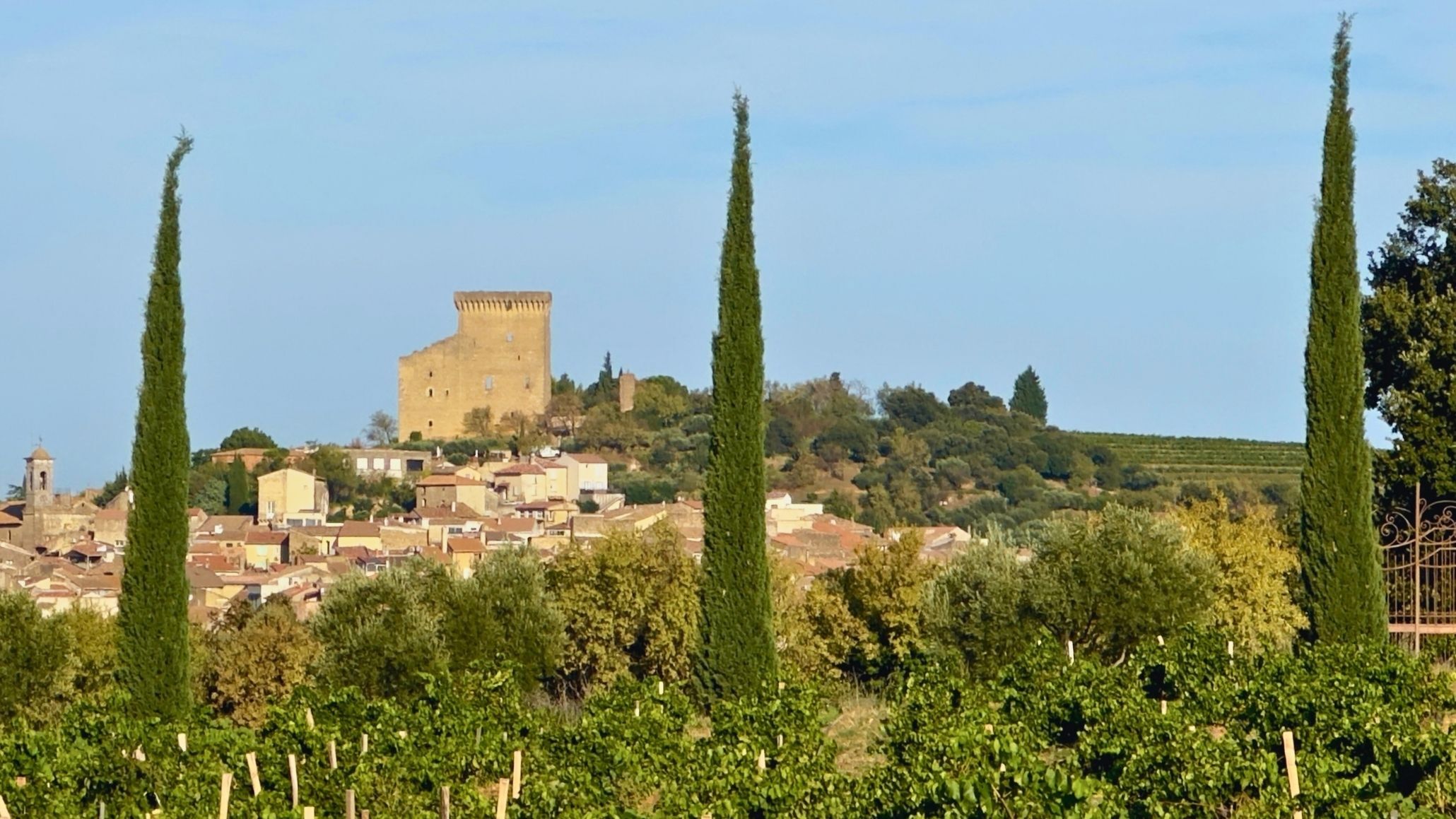
Historic château ruins overlook Châteauneuf-du-Pape, where contrasting vintages continue to test growers’ ability to adapt.
The 2025 Vintage
The 2025 growing season began with healthy water reserves following over 600 millimetres (mm) of rainfall in 2024, despite a dry November and December that delivered just 20 and 10 mm, respectively. Winter was initially cold and favorable for vine dormancy, with temperatures around 0°C (32°F) in the first half of January and Mistral winds reaching 120 km/h. Conditions turned wetter toward the end of March, replenishing water reserves in the soil. Rainfall reached a total of 150 mm between January 1 and March 18.
The growth cycle began relatively late, with sap flow around March 9 and budbreak in the earliest sites by the end of the month. Cool, unsettled conditions persisted through April, but there were no damaging spring frost incidents. Total rainfall reached around 320 mm by May 18 and increased downy mildew pressure, but subsequent Mistral winds helped maintain healthy vineyards. Flowering began on May 21, eight days later than in 2024, with abundant inflorescences initially suggesting a generous crop, as reported by Paul-Vincent Avril of Clos des Papes.
Flowering concluded on June 3, but coulure in Grenache (particularly in southern sectors) reduced potential yields. Fruit-set was complete by mid-June, after which warmer conditions accelerated vegetative and reproductive development. Vines had recovered from much of their earlier phenological delay and therefore entered summer in a more balanced position.
Throughout June, copper treatments against downy mildew kept winegrowers busy. Late June then marked a decisive shift toward hotter, drier conditions, with temperatures reaching 38°C (100.4°F) and less than 10 mm of rainfall for the month. July intensified this trend, reaching 40°C (104°F) on July 7. Drought and strong Mistral winds caused localized water stress and limited fruit growth, resulting in small berries. Véraison began around July 16 and advanced rapidly, moving the vines from their earlier delay into an advanced phenological position.
August heat of 35-40.5°C (95-105°F) accelerated ripening and increased the risk of shrivelled berries, particularly in southern sites and among rapidly advancing white varieties. The increasingly arid conditions posed a particular threat to heat-sensitive Roussanne, prompting several growers to commence their earliest harvests to date. Famille Isabel Ferrando started picking on August 14 ahead of an approaching heat wave, while Château de Vaudieu and Le Vieux Donjon both harvested their Roussanne on August 18, just before the roughly 20 mm of rain forecast for August 20. Others chose to begin their white grape harvest after the rainfall, such as Clos des Papes, whose harvest began on August 27.
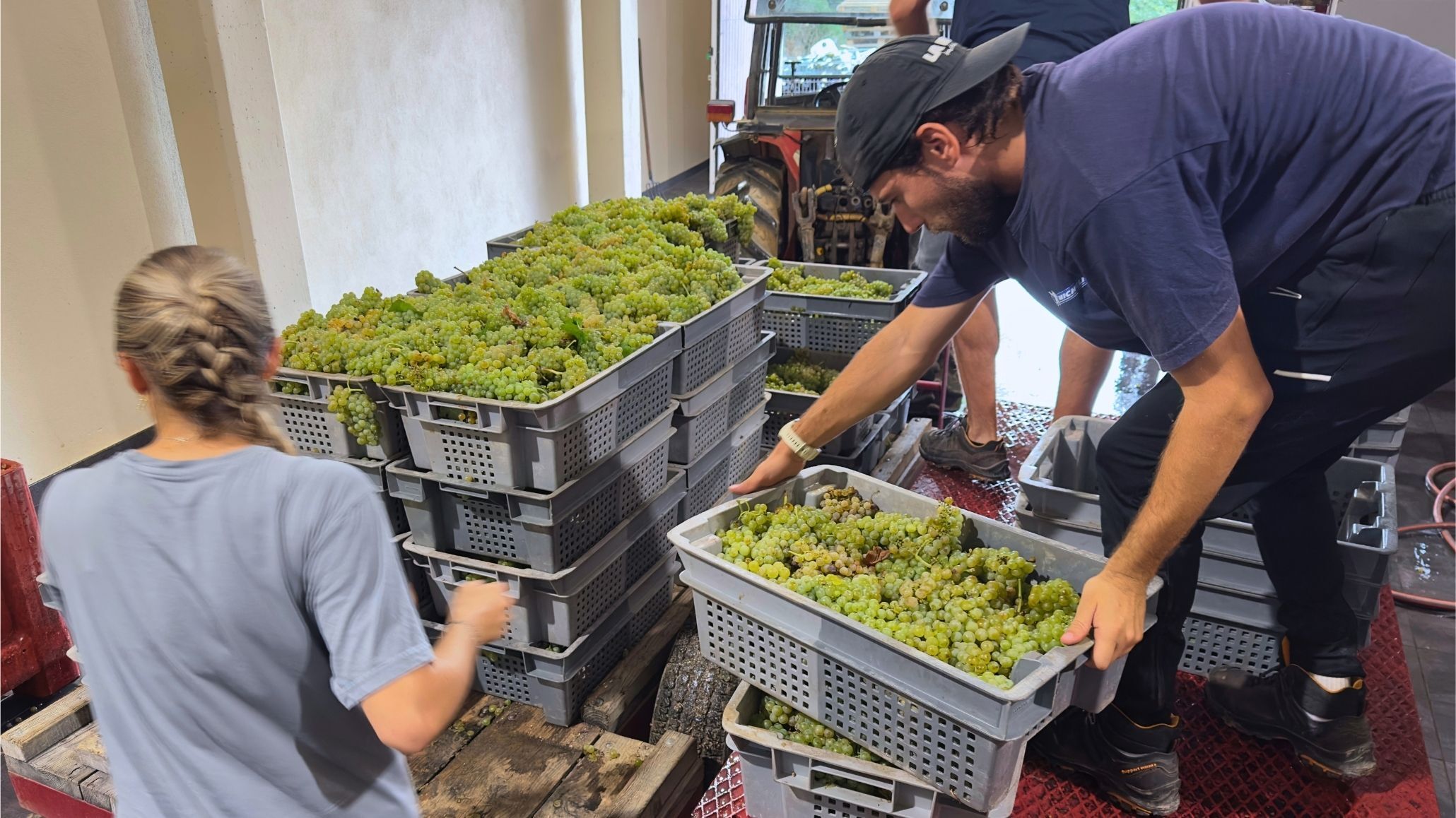
Roussanne grapes harvested at Château de Vaudieu in late August 2026.
Early September saw more rainfall and warm weather conditions, making it a challenge for growers to decide the best possible picking date. Nicolas Brunier of Domaine du Vieux Télégraphe recalled, “Rain at the beginning of September disrupted balance, complicating the assessment of optimal ripeness, while the prospect of a much heavier rainfall event — 90 mm on September 21 — added urgency.” In 2025, growers had considerable latitude regarding picking decisions, which then played a decisive role in the resulting wines. By contrast, in 2024, nature largely dictated when and how to act.
Paul-Vincent Avril similarly described 2025 as an irregular harvest, with Grenache proving particularly challenging. “It took time to reach phenolic maturity while sugars were already quite high, and the heavy rain forecast for September 21 forced me to harvest ahead of it,” he said. For growers who picked after the substantial rainfall, rigorous sorting became essential, as some bunches had already begun to develop botrytis. Famille Isabel Ferrando’s final harvest took place on September 23 with Counoise. Average yields for the appellation came in at 28.27 hl/ha, 14% above those of 2024 and 20% below those of the generous 2023 vintage.
The Wines
The 2025 reds are generally less concentrated than the 2022s (from another warm, low-yielding year) despite similar alcohol levels around 15%. In fact, the 2025s might be viewed as a stylistic midpoint between the 2022s and 2023s: They lack the sheer concentration and notable tannic structure of the 2022s but possess somewhat more substance and tannic grip than the 2023s. Interestingly, Châteauneuf-du-Pape whites often finished between 13.5% and 14% alcohol in 2025 as opposed to 14.5% and more, likely reflecting the widespread decision to pick early. While this helped preserve freshness, some wines lack the mid-palate richness and breadth found in more generous years.
A warm, solar vintage in marked contrast to the cooler, wetter 2024, 2025 is on track to be a good- to very-good vintage in Châteauneuf-du-Pape. One minor downside is a risk of oxidative instability in some wines, potentially linked to botrytis-affected fruit and the associated oxidative enzymes. Careful producer selection is therefore advisable. During my trip, the finest barrel samples I tasted were those from Château de Beaucastel, Clos des Papes, Domaine de Marcoux, Famille Isabel Ferrando and Le Clos du Caillou. While the 2025 Château Rayas wasn’t yet available for tasting, I did taste a gorgeous sample of the 2025 Château de Fonsalette, a Côtes-du-Rhône vinified at Château Rayas.
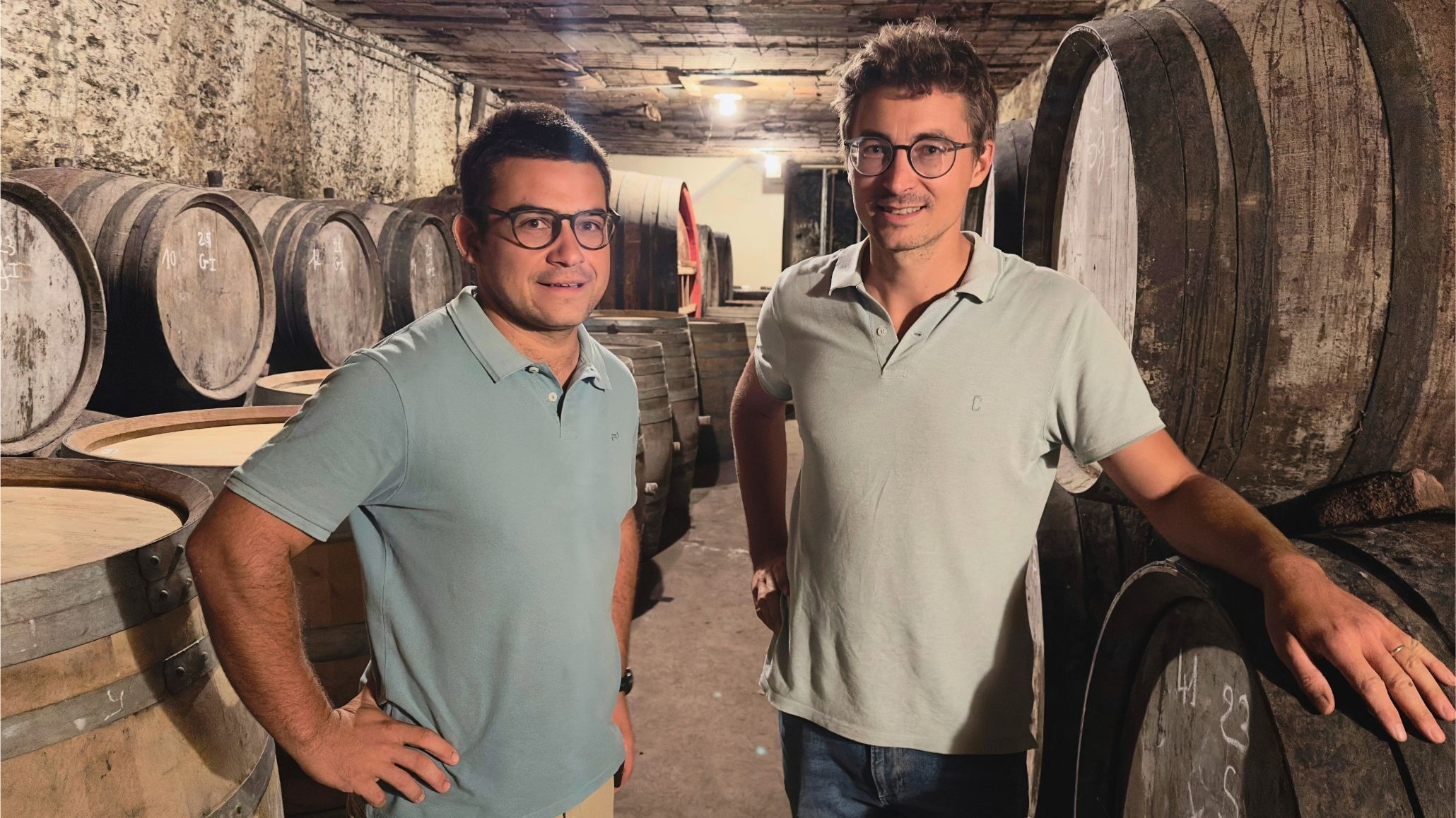
Louis-Damien Reynaud (left) and his brother Benoît (right) in the cellar at Château Rayas, less than a year after the death of their father, Emmanuel Reynaud. United in their determination to preserve Château Rayas, Château de Fonsalette and Château des Tours, the brothers are approaching this new chapter with continuity at heart.
A Final Word on 2024
Two words sum up the 2024 reds: elegant austerity. Grenache often takes a back seat in the blends, allowing Mourvèdre and Syrah to speak more clearly, with notes of licorice and white pepper replacing some of the strawberry fruit and Grenache-driven opulence found in 2022, 2023 and 2025. The wines are generally more restrained and savoury, with a cooler expression of fruit and less generosity through the mid-palate. Where the 2023s are immediately appealing and relatively easy to understand, the 2024s are more intellectual. Château Rayas, Château de Beaucastel, Clos des Papes and Domaine de la Vieille Julienne produced the most compelling 2024 reds.
The Many Whites of Châteauneuf-du-Pape
The appellation's white wine production has never been larger. It has also never been a monolith, and this plurality is far older than the recent growth. In 2025, Châteauneuf-du-Pape declared 88,271 hl of wine, of which 7,460 hl (8.5%) are white. That 8.5% is the highest percentage of white wine the appellation has recorded since its creation, and it arrives in a global market conspicuously hungry for serious white wine.
The temptation is to read this figure as a new development, but it is more accurate to say that a small, exceptionally varied category has become slightly less small. What strikes across the appellation is not a single trajectory but the number of ways to make a white in Châteauneuf-du-Pape — different varieties, soil types, training systems, cellar philosophies and intentions.
The deepest layer of this complexity is the extent of co-planted white varieties, as Jean-Paul Daumen at Domaine de la Vieille Julienne told me. Daumen’s ancestors planted that way, and every replanting of the past 25 years has followed suit. All his red wines except for one (Les Hauts-Lieux) carry up to 4% white varieties, picked at the same time as the red grapes. Daumen finds it fascinating that varieties with ostensibly different cycles reach broadly similar maturity together, and he argues the resulting complexity is unattainable any other way. That said, the appellation permits the same varieties in both red and white Châteauneuf-du-Pape, even if reds must ultimately meet a minimum colour intensity; the distinction between the two colours is therefore less clear-cut in the vineyard than it is in the finished wine.
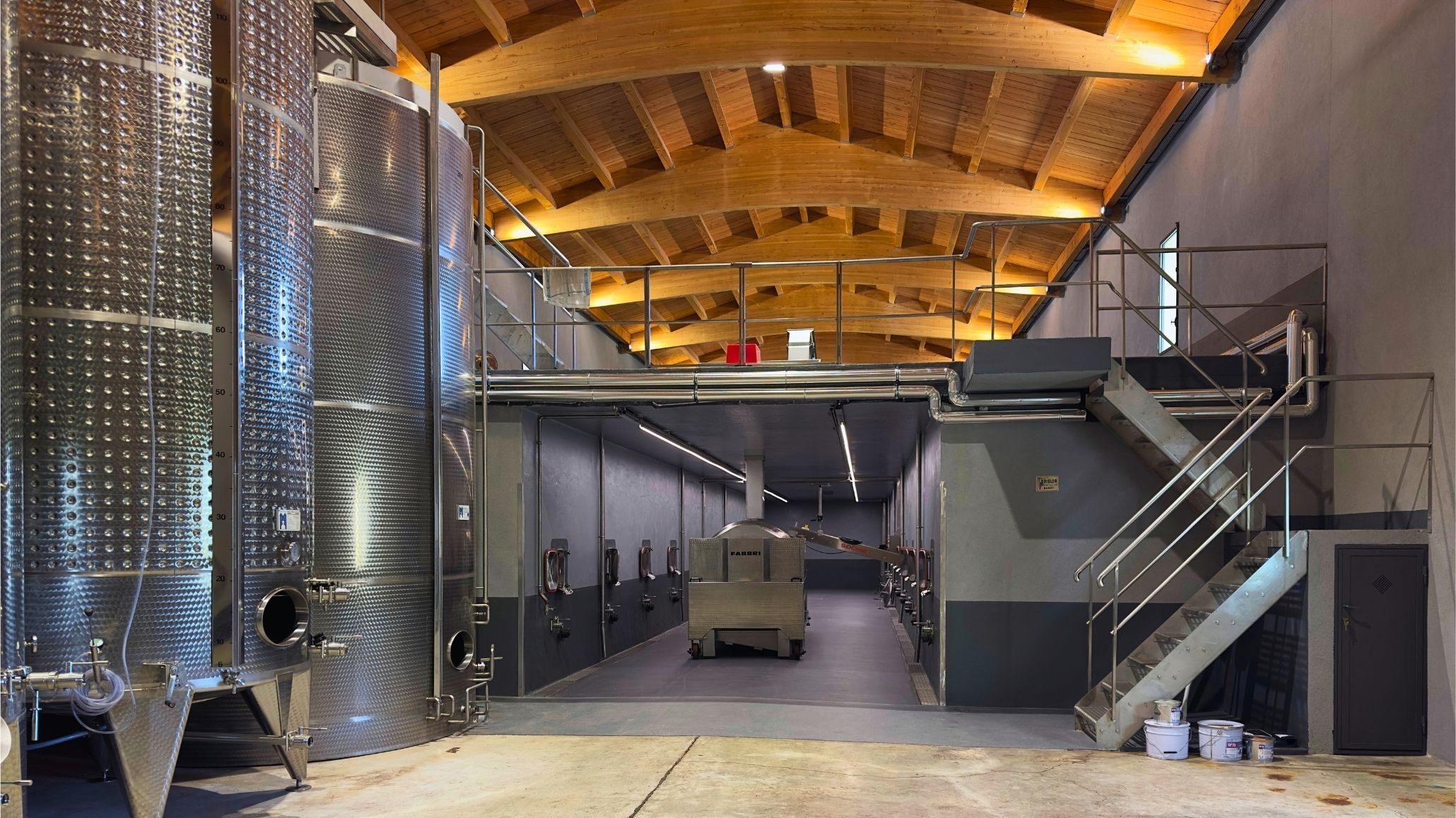
Clos des Papes’ new state-of-the-art cuverie.
The range of grape varieties in white Châteauneuf-du-Pape is broad: Grenache Blanc, Clairette, Roussanne, Bourboulenc, Terret Blanc, Picardan and Picpoul can all feature, alongside color variations such as Grenache Gris or Clairette Rose. For example, the Châteauneuf-du-Pape Blanc at Château de Beaucastel comprises mostly Roussanne, with percentages of Grenache Blanc, Clairette, Picpoul, Bourboulenc and Picardan. Clos des Papes also uses a mix of varieties, but in a more even distribution.
At Château de Vaudieu, Laurent Bréchet attributes each variety to a particular role within the blend: “Grenache Blanc provides structure, Roussanne adds richness, Clairette brings freshness and Picardan contributes aromatic lift.” Mas de Boislauzon takes yet another different tack, blending 50% Roussanne with 25% Clairette and 25% Grenache Blanc. These contrasting approaches mean that white Châteauneuf-du-Pape can vary considerably in style. Tasted side by side, they may be so different that it is not immediately obvious that they come from the same appellation.
Furthermore, the same variety can behave quite differently in sites separated by only a few kilometres. Beaucastel’s César Perrin keeps planting Roussanne; the estate lies in the northern sector on clay with a great deal of limestone, and Roussanne performs well there. Vieille Julienne’s Jean-Paul Daumen finds almost the opposite on his own sandy soils, judging that the variety concentrates and ripens too quickly.
Bourboulenc tells a similar story: César Perrin is increasing plantings for its acidity. Paul-Vincent Avril values Bourboulenc alongside Picpoul for how it creates a perception of freshness on the palate, noting, “The older generations always included these two varieties.”
Despite all this, the recent trend toward more white wine production also has to do with commercial realities. “Global sales markets are in a fragile state right now, so everybody is looking for something they can sell,” says Laurence Féraud of Domaine du Pegau, noting that her white Châteauneuf-du-Pape sells much faster than her red at the moment.
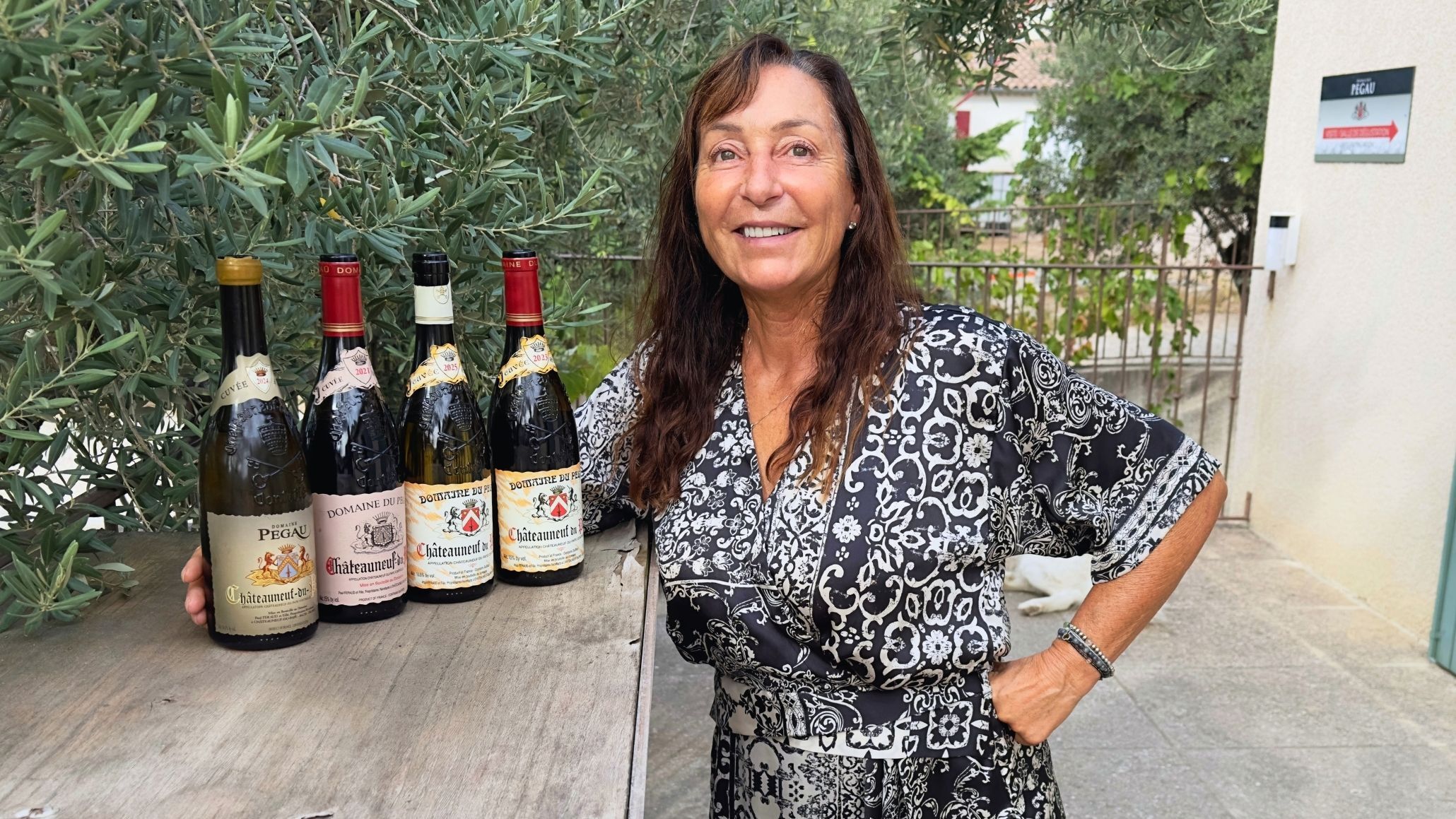
Domaine du Pegau’s Laurence Féraud presents her wines, with the 2024 Châteauneuf-du-Pape Blanc Cuvée A Tempo (the leftmost bottle) a particular standout.
Alongside this runs a stylistic recalibration, pursued by most through markedly varied routes. Mas de Boislauzon’s Joris Chaussy reflected that white Châteauneuf-du-Pape was once broader, richer and heavily shaped by Roussanne picked at elevated ripeness, but admitted, “We have moved away from that and gone slightly too far in the opposite direction.” Laurent Bréchet picks early, harvesting Picardan at around 13% potential alcohol (the appellation minimum is 12.5%) and blocking malolactic fermentation. Paul-Vincent Avril matures his white entirely in stainless steel and bottles after up to five months on lees, noting that pH values are no longer as favourably low as they once were.
Scale and ambition are the last variables at play. Château de Vaudieu’s Laurent Bréchet farms more than 11 hectares of white varieties — the appellation's largest white production for a single estate — and will expand to 14 hectares within two years. His parcels are large enough to generate viable individual lots of each variety, allowing the estate to press and ferment them separately. This is why Vaudieu can bottle as many as five different whites in a strong year — the traditional blend plus four varietal cuvées — whereas smaller growers may have too little fruit of any one variety to vinify it independently.
At the other end of the spectrum sits Isabel Ferrando, whose ambition is driven by conviction: “Clairette is my vision of white wine in the Southern Rhône,” she says, crediting Clairette with fresh tension and ageability, overturning the stereotype of white Châteauneuf as rich and fast-aging. According to Ferrando, the late Henri Bonneau once brought an unlabelled magnum of single-varietal 1947 Clairette, made by his father, to dinner at Saint Préfert. Its stunning freshness persuaded Ferrando to bottle her own old vines separately, beginning with the 2009 Cuvée Spéciale Vieilles Clairettes. Laurence Féraud shares a similar memory of her father’s 1989 Blanc de Noirs made from red Grenache. In Châteauneuf-du-Pape, some of the newest ideas about white wine keep turning out to be old ones.
My Top Ten White Châteauneuf-du-Papes (in alphabetical order)
• Château de Beaucastel Châteauneuf-du-Pape Blanc Roussanne Vieilles Vignes
• Château de Vaudieu Châteauneuf-du-Pape Blanc Les Vieilles Roussanne
• Château Rayas Châteauneuf-du-Pape Blanc Réserve
• Clos des Papes Châteauneuf-du-Pape Blanc
• Domaine de la Janasse Châteauneuf-du-Pape Blanc Prestige
• Domaine de Marcoux Châteauneuf-du-Pape Blanc
• Domaine du Pegau Châteauneuf-du-Pape Blanc Cuvée A Tempo
• Domaine du Vieux Télégraphe Châteauneuf-du-Pape Blanc La Crau
• Domaine La Barroche Châteauneuf-du-Pape Blanc Pure
• Famille Isabel Ferrando Châteauneuf-du-Pape Blanc Cuvée Spéciale Vieilles Clairettes
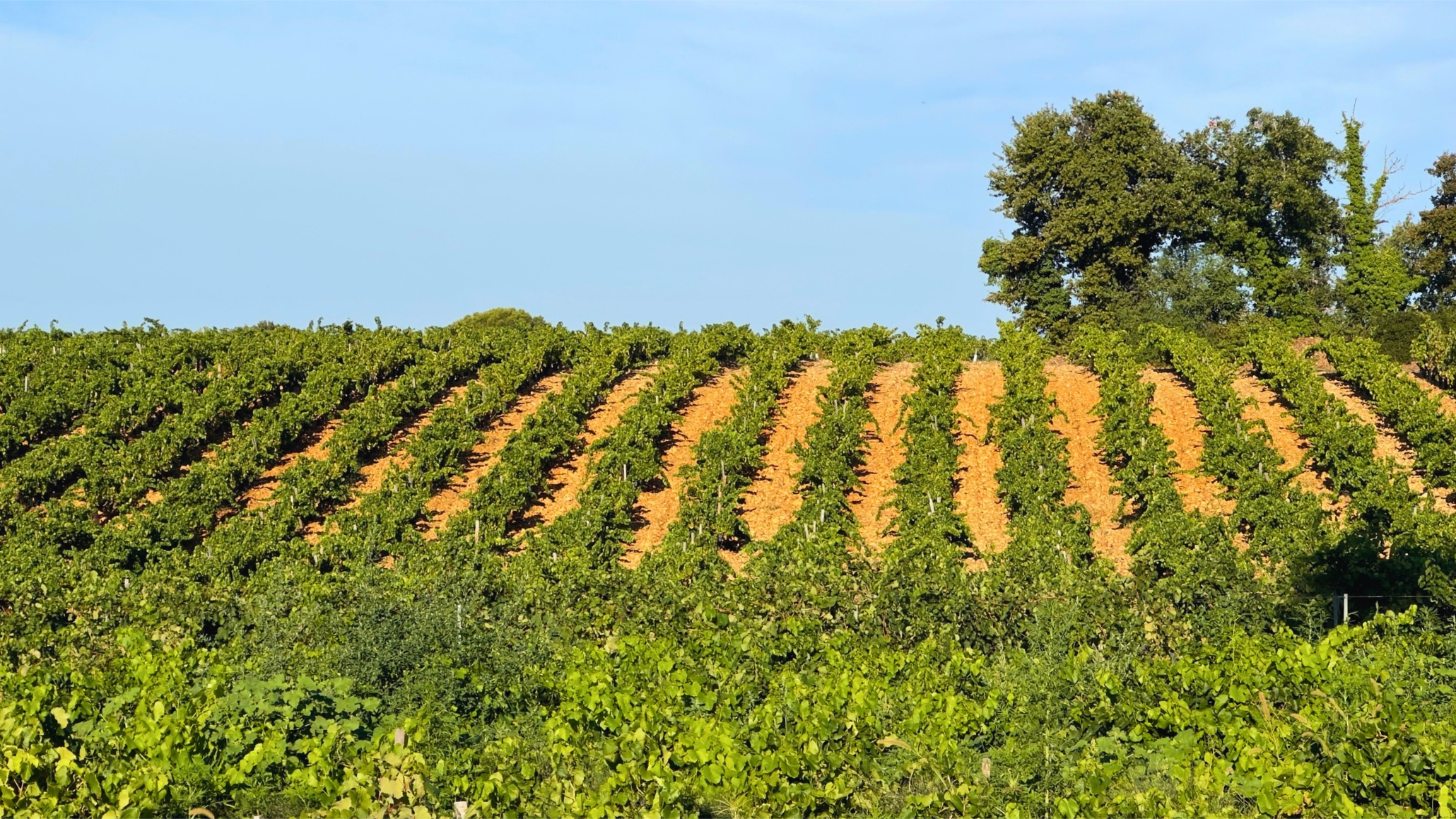
A vineyard in Châteauneuf-du-Pape, its soil covered with characteristic galets roulés shimmering beige-brown.
A First Glimpse at 2026
At the time of this writing, 2026 is shaping up to be an exceptionally early vintage in the Southern Rhône, with growers generally relaxed after a hot and dry season of remarkably low mildew pressure (many reported making only two to four treatments). Domaine du Vieux Télégraphe harvested their first white Châteauneuf grapes on August 17 (four days earlier than in 2025), while Château de Beaucastel brought in their first Roussanne and Syrah on August 21, the earliest harvest on record for both estates. Some unease has emerged regarding low acidities and low YAN levels (Yeast Assimilable Nitrogen, essential for healthy fermentations), and Ferrando reported instances of blocked ripening in Syrah. With harvest still underway, it is far too early to draw conclusions, but 2026 already promises to be another warm and notably precocious vintage in Châteauneuf-du-Pape.
I tasted the majority of the wines in this report in Châteauneuf-du-Pape in late August 2026, with follow-up tastings at my office in Zurich.
© 2026, Vinous. No portion of this article may be copied, shared or redistributed without prior consent from Vinous. Doing so is not only a violation of our copyright but also threatens the survival of independent wine criticism.
You Might Also Enjoy
Gigondas 2025: A Warm, Rain-Divided Vintage, Nicolas Greinacher, September 2026
Châteauneuf-du-Pape 2024: Dark Elegance, Nicolas Greinacher, October 2025
Châteauneuf-du-Pape: Alluring 2023s and Benchmark 2010s, Nicolas Greinacher, November 2024
Châteauneuf-du-Pape 2022: Bring It On, Nicolas Greinacher, June 2024
Châteauneuf-du-Pape New Releases: Welcome to the Pleasuredome, Nicolas Greinacher, June 2023
.
Show all the wines (sorted by score)
- Alain Jaume
- André Brunel
- Baron de Montfaucon
- Bosquet des Papes
- Château de Beaucastel
- Château de Fonsalette
- Château de la Font du Loup
- Château de la Gardine
- Château de Nalys
- Château de Vaudieu
- Château Fortia
- Château la Genestière
- Château La Nerthe
- Château Maucoil
- Château Mont-Redon
- Château Mont-Thabor
- Château Rayas
- Château Simian
- Château Sixtine
- Clefs des Papes
- Clos de l'Oratoire des Papes
- Clos des Papes
- Clos du Calvaire
- Clos Saint-Jean
- Clos Saint Michel
- Domaine Albin Jacumin
- Domaine Berthet-Rayne
- Domaine Brun-Avril
- Domaine Chante Cigale
- Domaine Charvin
- Domaine Clef de Saint-Thomas
- Domaine Comte de Lauze
- Domaine de Beaurenard
- Domaine de Cristia
- Domaine de Ferrand
- Domaine de la Célestière
- Domaine de la Charbonnière
- Domaine de la Côte de l'Ange
- Domaine de la Croze-Granier
- Domaine de la Janasse
- Domaine de la Mordorée
- Domaine de la Palud
- Domaine de la Vieille Julienne
- Domaine de Marcoux
- Domaine de Panisse
- Domaine de Pignan
- Domaine de Reveirolles
- Domaine de Saint Paul
- Domaine de Saje
- Domaine des Bosquets
- Domaine des Pères d'Eglise
- Domaine des Sénéchaux
- Domaine du Bois de Saint-Jean
- Domaine du Grand Tinel
- Domaine du Pegau
- Domaine du Père Caboche
- Domaine Durieu
- Domaine Duseigneur
- Domaine du Vieux Télégraphe
- Domaine Élodie Jaume
- Domaine Féraud et Fils
- Domaine Giraud
- Domaine Grand Veneur
- Domaine Juliette Avril
- Domaine La Barroche
- Domaine L'Abbé Dîne
- Domaine La Boutinière
- Domaine Mas Saint Louis
- Domaine Paul Autard
- Domaine Pierre Usseglio
- Domaine Raymond Usseglio & Fils
- Domaine Roger Perrin
- Domaine Roger Sabon
- Domaine Saint-Laurent
- Domaine Saint Siffrein
- Domaine Santa Duc
- Famille Brunier
- Famille Gras
- Famille Isabel Ferrando
- La Bastide Saint-Dominique
- La Ferme du Mont
- Lavau
- Le Clos du Caillou
- Les Clefs du Calads
- Le Vieux Donjon
- Mas de Boislauzon
- Mathieu Jérôme
- Mousset
- Ogier
- St Antonin
- Xavier Vignon